


Here you will find an overview of recommended websites

Jim Anderson warmly welcomes you to his website on nudibranchs, marine flatworms, and crustaceans.
URL: http://www.nudibranch.org/
Added: 27.05.2026
Associated Journal
We encourage users to publish their primary research on growth, weight-length relationships, reproduction (maturity, fecundity, spawning), food and diet composition, introductions and range extensions for faster subsequent entry in SeaLifeBase. A few journal options are available, one of which is Frontiers in Marine Science, Marine Biology section (Impact factor 2021: 3.7) in which a few members of the FishBase Consortium are serving as associated and review editors.
You are welcome to include text, numbers and maps from SeaLifeBase in your own web sites for non-commercial use, given that such inserts are clearly identified as coming from SeaLifeBase, with a backward link to the respective source page. Photos and drawings belong to the indicated persons or organizations and have their own copyright statements. Photos and drawings with CC-BY or CC-BY-NC copyrights can be used without further permission, with full attribution to the person or organization and the indication 'from SeaLifeBase'.
Note: SeaLifeBase was assembled with the help of many partners and with the support of the Oak Foundation and the Global Greengrants Fund. This site was developed using the FishBase web template. Contact us if you want to provide pictures, data, or reprints.
URL: https://www.sealifebase.ca/
Added: 23.10.2023 Updated: 25.10.2023

We, S&L Naturverlag, Ilmenau, edit, produce, and publish nature picture books, reference works, and identification guides specializing in the subject of marine aquariums.
We also provide information on the specific requirements for caring for marine animals (coral fish, flowers, crustaceans, etc.) in saltwater aquariums.
With outstanding photographs and a lively narrative style, these books captivate nature lovers and saltwater aquarium enthusiasts alike.
However, we also edit and publish works and manuscripts by authors on other nature-related topics, including their images and texts.
https://sl-naturverlag.de/buecher/
URL: https://www.sl-naturverlag.de
Added: 22.01.2026 Updated: 24.01.2026
All about the important marine snow
https://www.leibniz-zmt.de/de/forschung/wissenschaft-tropen/biogeochemie-geologie/ag-tropische-marine-mikrobiologie.html
Foto: NOAA National Ocean Service, public domain
Further information about marine snow
https://blogs.helmholtz.de/kuestenforschung/2020/05/04/highlight-thema-raetsel-um-den-schnee-im-meer/
URL: https://www.wissenschaftsjahr.de/2016-17/aktuelles/das-sagen-die-experten/mikrobiologie-und-meeresschnee.html
Added: 29.04.2023 Updated: 23.05.2023
Reef Life Survey is a non-profit citizen science program in which trained SCUBA divers undertake standardised underwater visual surveys of reef biodiversity on rocky and coral reefs around the world.
Images and information associated with all species recorded by Reef Life Survey divers are available through the Reef Species of the World pages on the RLS website, where users can use a map to search for species in the area of interest, and order results by how common they are
URL: https://reeflifesurvey.com/
Added: 11.03.2021 Updated: 20.05.2021
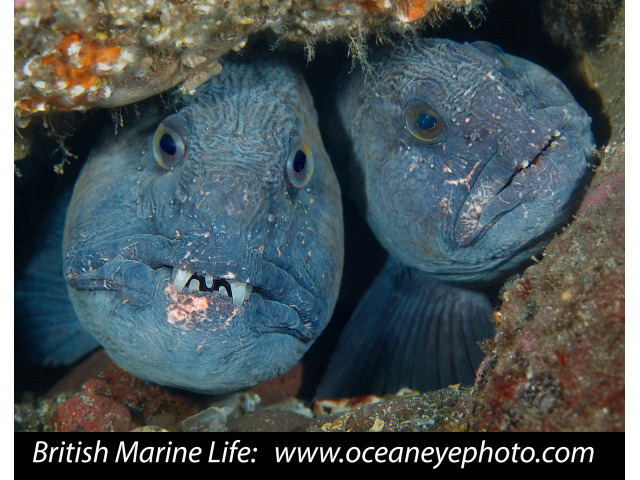
Welcome to British Marine Life Pictures, thank you for visiting.
The purpose of this website is an on-line image information resource.
All 1838 photographs shown were taken underwater and therefore the marine animals are seen in a natural context.
I hope you find the website interesting and useful. Feedback is very welcome.
HELP! – Within the gallery there is a portfolio named ‘Identification Required’ – if you can help identify any of the animals please leave a note using the 'Identify or Correct' or 'Contact Me' pages. Thank you!
New photographs will continue to be added.
This website was created in November 2008.
URL: https://www.britishmarinelifepictures.co.uk/
Added: 20.05.2021
Dennis Polack's Gallery
A comprehensive and fully relational fish database with more than 104,000 scientific species name combinations
More than 36 000 pictures <--> More than 170 albums
The only fish database on the internet that can be interrogated. - For some examples click on FAQs
Click on any displayed picture to open an Album of Pictures
URL: https://www.fishwisepro.com/Album/Default?GalleryId=23&View=True
Added: 16.05.2021 Updated: 18.05.2021

Besides each other, our greatest passions in life are discovering the wonders of the marine world, seeking out indigenous people and their art, and photographing and writing about our adventures.
For more than 40 years we’ve been lured across the globe to reveal the mysteries of our planet’s most remote underwater realms: the world’s longest underwater cave located in Mexico, sea snakes in Borneo, whale sharks in Papua, and schooling sharks in Fiji and Costa Rica.
In 2008 Conservation International hired us to consult on sustainable marine tourism initiatives in the most bio-diverse tropical ref environment on earth: Indonesia’s Raja Ampat and the surrounding Bird’s Head Seascape. Diving Indonesia’s Raja Ampat (2009) and Diving Indonesia’s Bird’s Head Seascape (2011) are the results of our explorations throughout this vast archipelago.
In 2014 we created and currently administer the Bird’s Head Seascape website. Besides diving and snorkeling information, the site provides details about sustainable tourism options, local news, conservation initiatives, groundbreaking scientific research, and stunning photography with the aim of conserving this region’s remarkable biodiversity.
URL: https://secretseavisions.com/
Added: 10.05.2026
The website Korallenriff.de contains about 2000 articles on the topic of seawater and was created in 1999. Whether plagues, fish behaviour, coral care, press releases, new products or home visits are the topics there.
URL: https://www.korallenriff.de
Added: 10.03.2021 Updated: 08.05.2026

Our Mission is Saving the World’s Coral Reefs
The Coral Reef Alliance (CORAL) is a non-profit, environmental NGO that is on a mission to save the world’s coral reefs. We work collaboratively with communities to reduce direct threats to reefs in ways that provide long-term benefits to people and wildlife. In parallel, CORAL is actively expanding the scientific understanding of how corals adapt to climate change and is applying this information to give reefs the best chance to thrive for generations to come. Our broad expertise uniquely positions us to rally the conservation community around scalable and effective solutions for coral reefs around the world.
URL: https://www.globalcoral.org/
Added: 18.04.2021 Updated: 08.05.2026

Welcome to Fish Stocks Online
Sustainable Fish Purchasing—But How?
“Fish Stocks Online” provides comprehensive, up-to-date, and scientifically verifiable information on the status of wild marine fish stocks that are significant for the German market.
The information is organized by individual fish stocks, which can develop in completely different ways. In addition, all other aspects relevant to the assessment of ecologically sustainable fisheries are described.
The site is maintained by the Thünen Institute, the German federal institute responsible for assessing commercially exploited fish stocks. It is aimed at the interested public, but especially at companies in the retail and processing industries. Of course, environmental organizations, schoolchildren, students, and members of the press are also invited to use the site as a source of information.
URL: https://www.fischbestaende-online.de/
Added: 06.05.2026 Updated: 08.05.2026
The Australian Institute of Marine Science (AIMS) is Australia’s tropical marine research agency.
We play a pivotal role in providing large-scale, long-term and world-class research that helps governments, industry and the wider community to make informed decisions about the management of Australia’s marine estate.
AIMS is a Commonwealth statutory authority established by the Australian Institute of Marine Science Act 1972.
URL: https://www.aims.gov.au/
Added: 11.03.2021 Updated: 06.05.2021
The aim of a World Register of Marine Species (WoRMS) is to provide an authoritative and comprehensive list of names of marine organisms, including information on synonymy. While the highest priority goes to valid names, other names in use are included so that this register can serve as a guide to interpret taxonomic literature.
The content of WoRMS is controlled by taxonomic and thematic experts, not by database managers. WoRMS has an editorial management system where each taxonomic group is represented by an expert who has the authority over the content, and is responsible for controlling the quality of the information. Each of these main taxonomic editors can invite several specialists of smaller groups within their area of responsibility to join them.
Resources to build MarineSpecies.org and Aphia were provided mainly by the EU Network of Excellence ‘Marine Biodiversity and Ecosystem Functioning’ (MarBEF), and also by the EU funded Species 2000 Europe and ERMS projects.
Aphia contains valid species names, synonyms and vernacular names, and extra information such as literature and biogeographic data. Besides species names, Aphia also contains the higher classification in which each scientific name is linked to its parent taxon. The classification used is a ‘compromise’ between established systems and recent changes. Its aim is to aid data management, rather than suggest any taxonomic or phylogenetic opinion on species relationships.
Keeping WoRMS up-to-date is a continuous process. New information is entered daily by the taxonomic editors and by the members of our data management team. Often data also come in from contributions of large datasets, such as global or regional species lists. No database of this size is without errors and omissions. We can’t promise to make no errors, but we do promise to follow up and give feedback on any communications pointing out errors. Feedback is very welcome!
URL: http://www.marinespecies.org/
Added: 11.03.2021 Updated: 06.05.2021
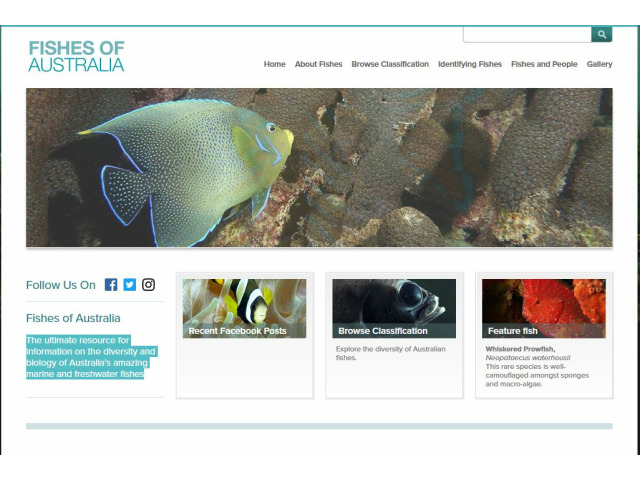
The ultimate resource for information on the diversity and biology of Australia’s amazing marine and freshwater fishes.
URL: https://fishesofaustralia.net.au/
Added: 12.03.2021 Updated: 06.05.2021
Dr. J.E.N. "Charlie" Veron, the "Godfather of Corals" has created the site "Corals of the World" to provide great assistance in identifying stony corals from around the world.
The site features almost all stony corals with color pictures, and for specialists, the coral skeleton as well.
It is worthwhile for all coral lovers to browse on the great site, and maybe even identify their own corals.
Have fun with this site!
URL: http://www.coralsoftheworld.org/page/home/
Added: 30.03.2021 Updated: 06.05.2021

Poppe Images
Has the aim to document a maximum of the Marine Life in the Philippines. During the expeditions of Guphil I, Guido & Philippe Poppe started photographing systematically all marine creatures. This resulted in a fast growing library of documented digital pictures which is obviously important for many people such as zoologists, museologists, divers, photographers, and others.
See also this page:
Choncology
https://www.conchology.be/?t=1
URL: https://www.poppe-images.com/
Added: 06.04.2026

FishBase is an online database with information and images of over 34,100 fish species, 324,100 names, 59,400 images, 55,700 references, and 2,330 partners. The site, with an average of 100,000 hits per month,[2] is offered free of charge. It can also be purchased on CD-ROM. Partners provide images and videos free of charge, but retain copyright. Much of the data can be plotted against each other from any browser. Entries of which the geographic coordinates are known can be displayed as interactive maps. An identification key and several teaching projects are also included.
URL: https://www.fishbase.de/
Added: 12.03.2021 Updated: 04.04.2026
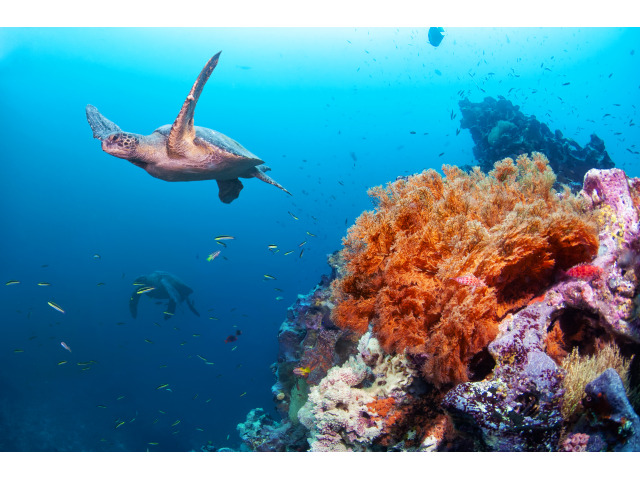
Fascinating life in the deep sea – wonders of nature
URL: https://www.wwf.de/themen-projekte/meere-kuesten/meeresraumzerstoerung/tiefseebergbau/faszinierendes-leben-in-der-tiefsee
Added: 29.04.2023 Updated: 03.05.2023
Welcome to the Bird’s Head Seascape, a mind-blowingly diverse repository for tropical marine life and rare and endemic birds, mammals, insects and plants.
The global epicentre of marine biodiversity, the BHS comprises more than 225,000 square kilometers (22.5 million hectares) in West Papua, Indonesia, including Cenderawasih Bay in the east, the Raja Ampat archipelago in the west, and the Kaimana Regency and Triton Bay in the south. Established as a multi-partner conservation initiative in 2004, the Bird’s Head Seascape initiative's aim is to secure the long-term effective management of the rich marine resources of the BHS in a manner that ensures food security and sustainable economic benefits for its citizens while also preserving its globally significant biodiversity. The centerpiece of the initiative is a network of 26 MPAs, protecting 5,229,782 hectares, spread across the seascape that can only be described as “scuba diving heaven”.
Contributors to this site have spent more than a decade exploring the most remote underwater regions of the Bird’s Head. With over 200 documented dive sites, we’ve found something to please just about everyone, but we strongly encourage all divers to continue our explorations. Through this site you can let us know what you find and post pictures of new dives and the interesting marine life you've observed and photographed in the BHS.
While this site is focused primarily on marine tourism, you’ll also find information on visiting the area’s topside attractions, getting to know its people, the exciting scientific research happening throughout the BHS, and recent posts from conservationists working to discover and conserve the BHS’s treasure trove of biodiversity.
We welcome your input and comments, and encourage everyone to share their recent experiences and latest images from the BHS on this site. Dive in!
worldMapContext
About The Bird’s Head Seascape
Heart of the Coral Triangle and the global epicenter of marine biodiversity with the highest coral reef biodiversity for any area its size in the world
22.5 million hectares with over 2500 islands and reefs
1894 species of reef fish
600+ species of corals
17 species of whales and dolphins; significant cetacean migration routes and aggregation sites
Some of the world’s most extensive mangrove forest and sea grass beds, which support dugongs, juvenile fish, saltwater crocodiles, and provide protection and food for the people of the BHS
World's largest Pacific leatherback turtle nesting beaches, with regionally significant nesting sites for green, olive ridley, and hawksbill turtles
22.5 million hectares protected by a network of 26 Marine Protected Areas, strongly supported by the communities that surround and live within them
The Coral Triangle's first shark and ray sanctuary, located in Raja Ampat, that provides strict protection to all sharks and rays, as well as turtles, dugongs and endemic fishes
Over 200 internationally acclaimed scuba diving sites
Cenderawasih Bay: Indonesia’s largest marine national park
775,000 people with rich, diverse cultures and tribal traditions
Endemic birds of paradise, rare plants and insects, karst spires, densely forested peaks, and deserted beaches
An unprecedented partnership between coastal communities, local and national governments, international and local NGOs, and academic institutions ensures sustainable management of the Bird’s Head Seascape’s resources
Home of the Stegostoma tigrinum Augmentation and Recovery (StAR) Project, the world’s first rewilding program for a threatened shark species, with nearly 50 endangered leopard shark pups successfully rewilded to date
Hosting (in Raja Ampat) the world’s first documented population of reef manta rays that is INCREASING in number (averaging 7% increase per annum)
mapOverview
The Seascape Initiative
The Bird’s Head Seascape initiative was established in 2004. Dependent on the strong union of international NGOs and local, regency, provincial and national governments, coastal communities, local organizations, and universities, the initiative seeks to balance the needs of the Seascape’s human population while effectively protecting its rich natural resources. The Bird’s Head’s original network of 12 multiple-use marine protected areas (MPAs) formed the core of this initiative. The BHS exemplifies the priorities of the six-nation Coral Triangle Initiative, and is being promoted as a national model for Indonesia’s future marine resource management.
People of the BHS
The first humans to populate Papua crossed the shallow Arafura Sea from Australia about 5,000 years ago. Little is known about Papua’s contact with the outside world prior to the 15th century, when trade routes were established between Papua and the multiplying networks of spice-rich Sultanates to the west. The region quickly became a crossroads for traders who had traveled east on monsoon winds to exchange metal tools and cloth for Papuan products like Bird of Paradise feathers and massoy bark, which was used in many traditional medicines of the day.
By the early 16th century the burgeoning spice trade encompassed all the islands between the Moluccas and New Guinea. The Portuguese spearheaded the influx of European spice traders, followed closely by the Spanish, Dutch and British. Through their treaty with the Sultan of Tidore, the Dutch finally asserted their sovereignty over Papua at the end of the 17th century. Dutch rule over Papua continued during World War II when the north coast, especially Manokwari, became a focal point of battles between the Allies and the Japanese. General MacArthur built a major base on Biak, just at the outer edge of Cenderawsih Bay. Additional remnants of WWII can be seen at several abandoned airstrips along Papua’s north coast and the nearby submerged wrecks, which attract scuba divers.
After the war, most of what is modern Indonesia gained independence from the Dutch, but colonial authorities did not relinquish their control over Papua until 1962. For the next 30 years immigrants from the rest of the Indonesian archipelago sought business opportunities in Papua, but few ventured into the Seascape’s more isolated coastal areas. Today, however, potential employment in the petroleum, mining, logging, and tourism industries has attracted workers to the Bird’s Head from Indonesia and around the world.
Naturalist and Scientific Surveys in the BHS
Since the early 19th century, naturalists have visited areas of the Seascape. The French zoologists Quoy and Gaimard collected the first marine fishes described from the region, and identified such ubiquitous species as the blacktip reef shark, big-eye trevally, bluefin trevally, semi-circular angelfish, and the circumtropical sergeant major while in Raja Ampat. During the 1860s, Dutch ichthyologist Peter Bleeker added over 100 species to the Seascape’s fish count. During the same period, British naturalist Alfred Russel Wallace journeyed by sailing canoe around Raja Ampat’s Waigeo Island in search of birds of paradise and endemic insects, and wrote about the area’s singular beauty.
Modern surveys began in 2001 with the rapid assessment survey of Raja Ampat’s reefs conducted by the Indonesian Institute of Sciences (LIPI) and Conservation International, led by Dr. Gerald Allen. Since that first survey, more than a decade’s worth of surveys and studies have confirmed the BHS’s superlative biodiversity, and stressed balancing the needs of the environment with the needs of the people who live in the BHS.
URL: https://birdsheadseascape.com/
Added: 01.05.2026