


 Nature Convention

Info
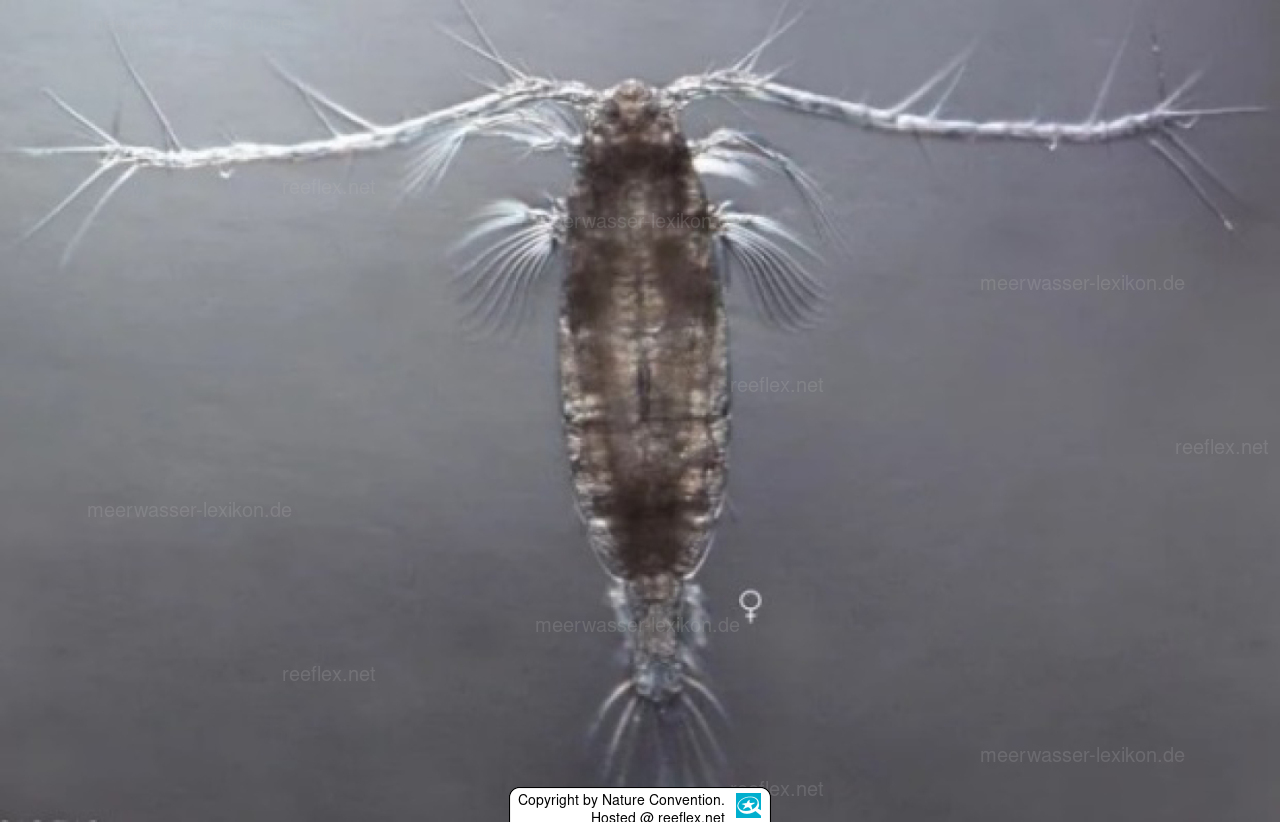
In general, copepods are the natural first food for many fish and crustacean larvae. No additional enrichment is necessary, in contrast to Artemia and Brachionus. Acartia tonsa (adult + junvenile) belongs to the pelagic (free-swimming) copepod species.
Environmental requirements
20 - max. 25°C
density 1.020
no lighting - daylight
Food for optimal copepod reproduction.
Rhodomonas baltica, Rhodomonas salina (2003), Tisochrysis lutea, Isochrysis galbana, Rhinomonas reticulata, Chaetoceros muelleri, Tetraselmis suecica
Reproduction rate or population dynamics.
The reproduction rate is based on density/salinity, feed quality, feed density and temperature.
Contamination
Contamination with Brachionus plicatilis can occur by no filtering with a sieve, as both species live in the same size spectrum. It is best to start a new culture, either with a new acquisition via the trade or a separation of individual copepods, but this is only advisable with a microscope so that no Brachionus is pipetted along.
Use as rearing feed.
Initial feeding of copepods to larval fish and crustaceans has a better starting point in skeletal deformations, pigmentation, survival rate and the growth rate in the larval stage.
The copepods generally have.... higher levels of eicosapentaenoic acid (EPA) and docosahexaenoic acid (DHA) and arachidonic acid (ARA), as well as iodine* than enriched brachionus and Artemia. Of course, feeding different types of algae to copepods can still bring improved nutrient requirements per larval species.
*Iodine
Is an important ingredient for the production of thyroid hormones and metamorphosis to succeed. Depending on the copepod species, the proportion can be up to 700 times higher than in Artemia.
Breeding kits
In various shops (see further links) there is the possibility to purchase cysts in order to grow them as needed.
Caution:
If cysts are stored refrigerated at 4°C, the hatching rate is reduced by approx. 4 % per month, after 6 months a reduction of approx. 50 % is to be expected.
Synonyms:
Acartia (Acanthacartia) giesbrechti Dahl, 1894 · unaccepted
Acartia giesbrechti Dahl F., 1894 · unaccepted
Acartia gracilis Herrick, 1887 · unaccepted
Acartia tonsa Dana, 1849-1852 · alternative representation
Environmental requirements
20 - max. 25°C
density 1.020
no lighting - daylight
Food for optimal copepod reproduction.
Rhodomonas baltica, Rhodomonas salina (2003), Tisochrysis lutea, Isochrysis galbana, Rhinomonas reticulata, Chaetoceros muelleri, Tetraselmis suecica
Reproduction rate or population dynamics.
The reproduction rate is based on density/salinity, feed quality, feed density and temperature.
Contamination
Contamination with Brachionus plicatilis can occur by no filtering with a sieve, as both species live in the same size spectrum. It is best to start a new culture, either with a new acquisition via the trade or a separation of individual copepods, but this is only advisable with a microscope so that no Brachionus is pipetted along.
Use as rearing feed.
Initial feeding of copepods to larval fish and crustaceans has a better starting point in skeletal deformations, pigmentation, survival rate and the growth rate in the larval stage.
The copepods generally have.... higher levels of eicosapentaenoic acid (EPA) and docosahexaenoic acid (DHA) and arachidonic acid (ARA), as well as iodine* than enriched brachionus and Artemia. Of course, feeding different types of algae to copepods can still bring improved nutrient requirements per larval species.
*Iodine
Is an important ingredient for the production of thyroid hormones and metamorphosis to succeed. Depending on the copepod species, the proportion can be up to 700 times higher than in Artemia.
Breeding kits
In various shops (see further links) there is the possibility to purchase cysts in order to grow them as needed.
Caution:
If cysts are stored refrigerated at 4°C, the hatching rate is reduced by approx. 4 % per month, after 6 months a reduction of approx. 50 % is to be expected.
Synonyms:
Acartia (Acanthacartia) giesbrechti Dahl, 1894 · unaccepted
Acartia giesbrechti Dahl F., 1894 · unaccepted
Acartia gracilis Herrick, 1887 · unaccepted
Acartia tonsa Dana, 1849-1852 · alternative representation

