


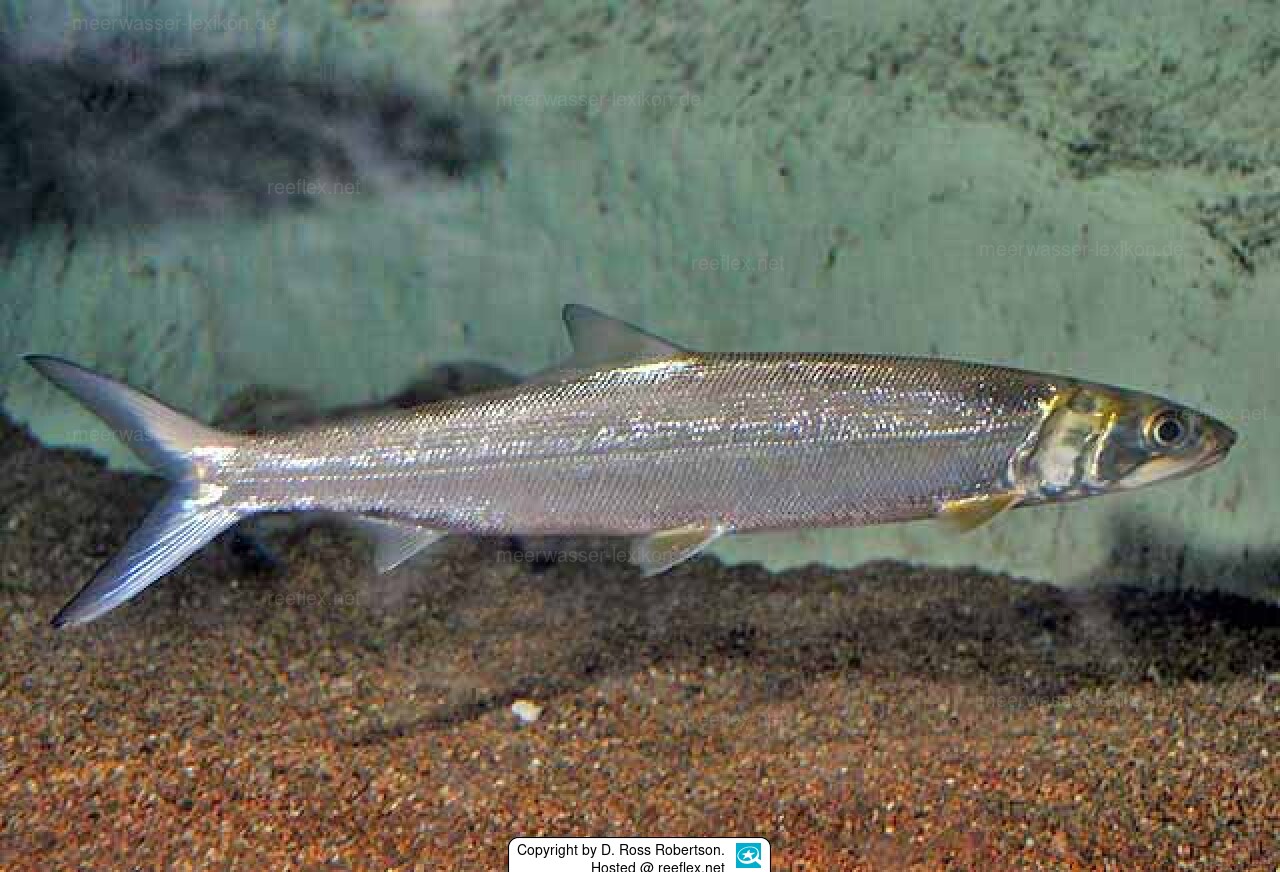
 Dr. D. Ross Robertson, Panama


Info
Elops saurus is silvery with bluish to greenish tones on the top of the body, the fins sometimes have a yellow tint.
Live adults are bright silver, especially on the sides, they may be bluish-gray on the back with yellowish tint to the fins
This long, slender, silvery fish has elongated and pointed fins, including a deeply forked caudal fin. It grows up to three feet long and weighs up to 15 pounds. Although anglers sometimes enjoy catching the ladyfish, it is not considered particularly tasty. Ladyfish are very tolerant of brackish water and are found in lagoons and bays as well as several miles out to sea.
Elops saurus is widely distributed in Florida, where it is commonly caught in mangrove areas and other nearshore waters, estuaries, and bays on sandy and muddy bottoms.
The ladyfish is also found in "big rivers" in the Chesapeake Bay region, including around Cape Charles and Lynnhaven Roads, Virginia
Habitats: Estuaries, hypersaline lagoons, and shallow coastal waters, especially in bays, lagoons, and mangrove areas; adults live further offshore.
It tolerates a wide range of salinities.
Occasionally this fish is found several miles offshore. The ladyfish prefers open water areas in channels with moderate currents, as well as shallow bars and eddies at river bends.
Because it is a heat-loving fish, the ladyfish has been observed in cold-related fish kills in Florida; it can tolerate low temperatures for only a short time.
Synonyms:
Elops inermis Mitchill, 1814
Elopidae saurus Linnaeus, 1766
Live adults are bright silver, especially on the sides, they may be bluish-gray on the back with yellowish tint to the fins
This long, slender, silvery fish has elongated and pointed fins, including a deeply forked caudal fin. It grows up to three feet long and weighs up to 15 pounds. Although anglers sometimes enjoy catching the ladyfish, it is not considered particularly tasty. Ladyfish are very tolerant of brackish water and are found in lagoons and bays as well as several miles out to sea.
Elops saurus is widely distributed in Florida, where it is commonly caught in mangrove areas and other nearshore waters, estuaries, and bays on sandy and muddy bottoms.
The ladyfish is also found in "big rivers" in the Chesapeake Bay region, including around Cape Charles and Lynnhaven Roads, Virginia
Habitats: Estuaries, hypersaline lagoons, and shallow coastal waters, especially in bays, lagoons, and mangrove areas; adults live further offshore.
It tolerates a wide range of salinities.
Occasionally this fish is found several miles offshore. The ladyfish prefers open water areas in channels with moderate currents, as well as shallow bars and eddies at river bends.
Because it is a heat-loving fish, the ladyfish has been observed in cold-related fish kills in Florida; it can tolerate low temperatures for only a short time.
Synonyms:
Elops inermis Mitchill, 1814
Elopidae saurus Linnaeus, 1766


