


 Dr. Eric Pante, Frankreich

Info
The Greek prefix "pseudo", means "false" or "spurious", and is used in reference to the morphological similarity between this new taxon and the established Chrysogorgia.
This similarity is reflected by the morphological parsimony analysis, in which Pseudochrysogorgia is most closely related to Chrysogorgia, not Metallogorgia.
Therefore, this genus combination was chosen over a combination with Metallogorgia because confusion of this new taxon for Chrysogorgia is more likely than confusion with Metallogorgia.
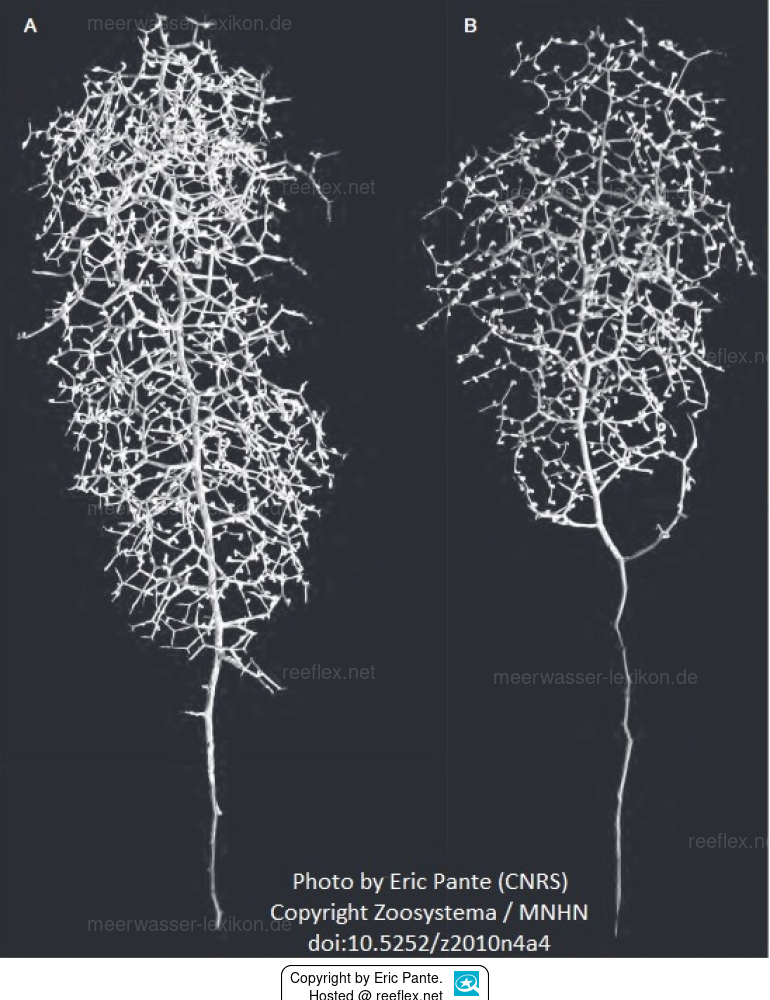
The colony is bottle-bush shaped, and its main axis is monopodial and slightly zigzag. The branches divide dichotomously into several levels.
Living colonies of Pseudochrysogorgia bellona are black and dull at the base and are characterized by a dark metallic sheen
The stem is stiff, robust and much thicker than the base of the branches along the colony, the branches are stiff and spring off the main axis at almost right angles.
Branching occurs in several planes. The holotype and paratype MNHN-IC.2008-007 were associated with hydroids attached to the
were attached to the tips of some branches.
No brittle stars were observed in the colonies examined.
On average, the polyps are as wide as they are tall.
Etymology:
The species name "bellona" refers to the coral's locality, the Bellona Plateau, in the Coral Sea, west of New Caledonia (southwestern Pacific Ocean).
.
This similarity is reflected by the morphological parsimony analysis, in which Pseudochrysogorgia is most closely related to Chrysogorgia, not Metallogorgia.
Therefore, this genus combination was chosen over a combination with Metallogorgia because confusion of this new taxon for Chrysogorgia is more likely than confusion with Metallogorgia.
The colony is bottle-bush shaped, and its main axis is monopodial and slightly zigzag. The branches divide dichotomously into several levels.
Living colonies of Pseudochrysogorgia bellona are black and dull at the base and are characterized by a dark metallic sheen
The stem is stiff, robust and much thicker than the base of the branches along the colony, the branches are stiff and spring off the main axis at almost right angles.
Branching occurs in several planes. The holotype and paratype MNHN-IC.2008-007 were associated with hydroids attached to the
were attached to the tips of some branches.
No brittle stars were observed in the colonies examined.
On average, the polyps are as wide as they are tall.
Etymology:
The species name "bellona" refers to the coral's locality, the Bellona Plateau, in the Coral Sea, west of New Caledonia (southwestern Pacific Ocean).
.

