


 Dr. John Ernest (Jack) Randall (†), Hawaii

Info
Meganthias natalensis is a deep-water anthias species with little data and very little information available on its life history, ecology and biology.
What is known is that Meganthias (large anthias) is a bentho-pelagic species that is caught from time to time by sport fishermen, and there are plenty of photos of this colorful animal on the internet.
With a total length of over 50 cm, it is not an animal for a home aquarium!
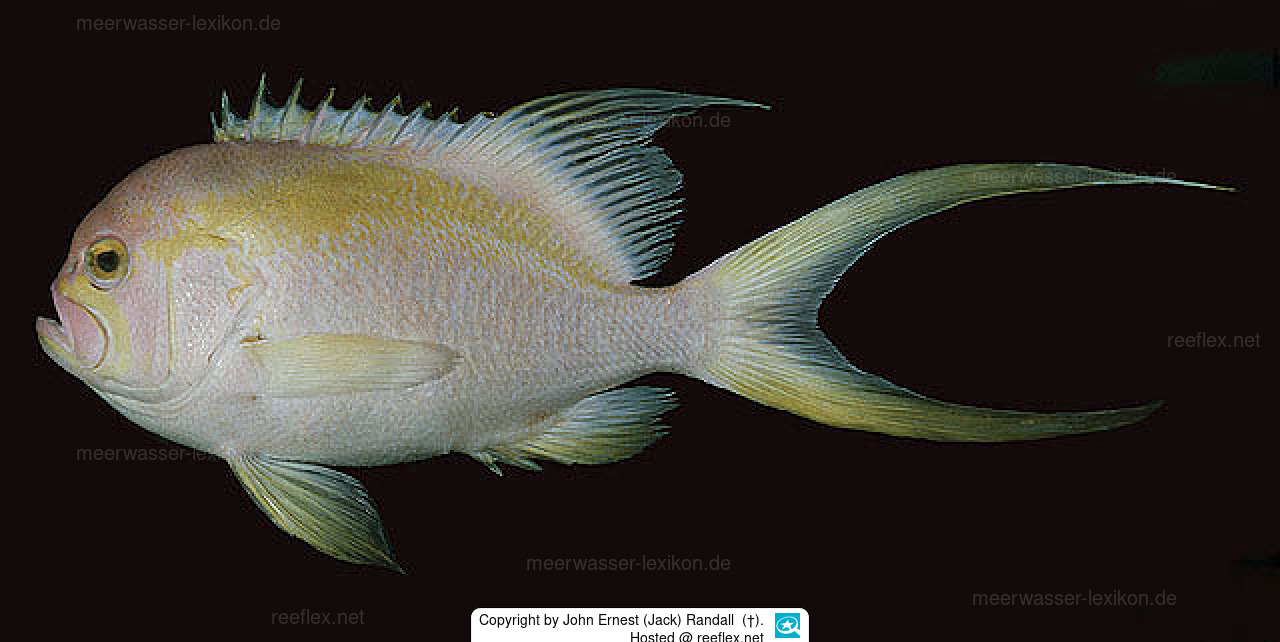
The head and body of this flag perch are bright reddish-pink dorsally, becoming lighter ventrally to pale pink or cream, the iris yellow.
A yellow band also extends around the mouth to the edge of the eye sockets and forms a narrower band below the mouth.
Another yellow band, which begins at the tip of the preopercle, widens over the upper flank and narrows again below the soft dorsal fin, extends to the origin of the peduncle.
The anal fin is yellow, the first elongated rays of the soft dorsal fin, pelvic fins and pectoral fins are yellow to pale yellow.
The deeply forked tail and the long, tapering caudal fin lobes are particularly striking.
The perch has a broad head, its lower jaw protrudes when the mouth is open.
Juveniles have a small tooth spot on their tongue, which is missing in adults.
Synonyms:
Glaucosoma peaolopesi Smith, 1939
Holanthias furcatus Pellegrin, 1935
Holanthias natalensis (Fowler, 1925)
Sacura natalensis Fowler, 1925
What is known is that Meganthias (large anthias) is a bentho-pelagic species that is caught from time to time by sport fishermen, and there are plenty of photos of this colorful animal on the internet.
With a total length of over 50 cm, it is not an animal for a home aquarium!
The head and body of this flag perch are bright reddish-pink dorsally, becoming lighter ventrally to pale pink or cream, the iris yellow.
A yellow band also extends around the mouth to the edge of the eye sockets and forms a narrower band below the mouth.
Another yellow band, which begins at the tip of the preopercle, widens over the upper flank and narrows again below the soft dorsal fin, extends to the origin of the peduncle.
The anal fin is yellow, the first elongated rays of the soft dorsal fin, pelvic fins and pectoral fins are yellow to pale yellow.
The deeply forked tail and the long, tapering caudal fin lobes are particularly striking.
The perch has a broad head, its lower jaw protrudes when the mouth is open.
Juveniles have a small tooth spot on their tongue, which is missing in adults.
Synonyms:
Glaucosoma peaolopesi Smith, 1939
Holanthias furcatus Pellegrin, 1935
Holanthias natalensis (Fowler, 1925)
Sacura natalensis Fowler, 1925

