


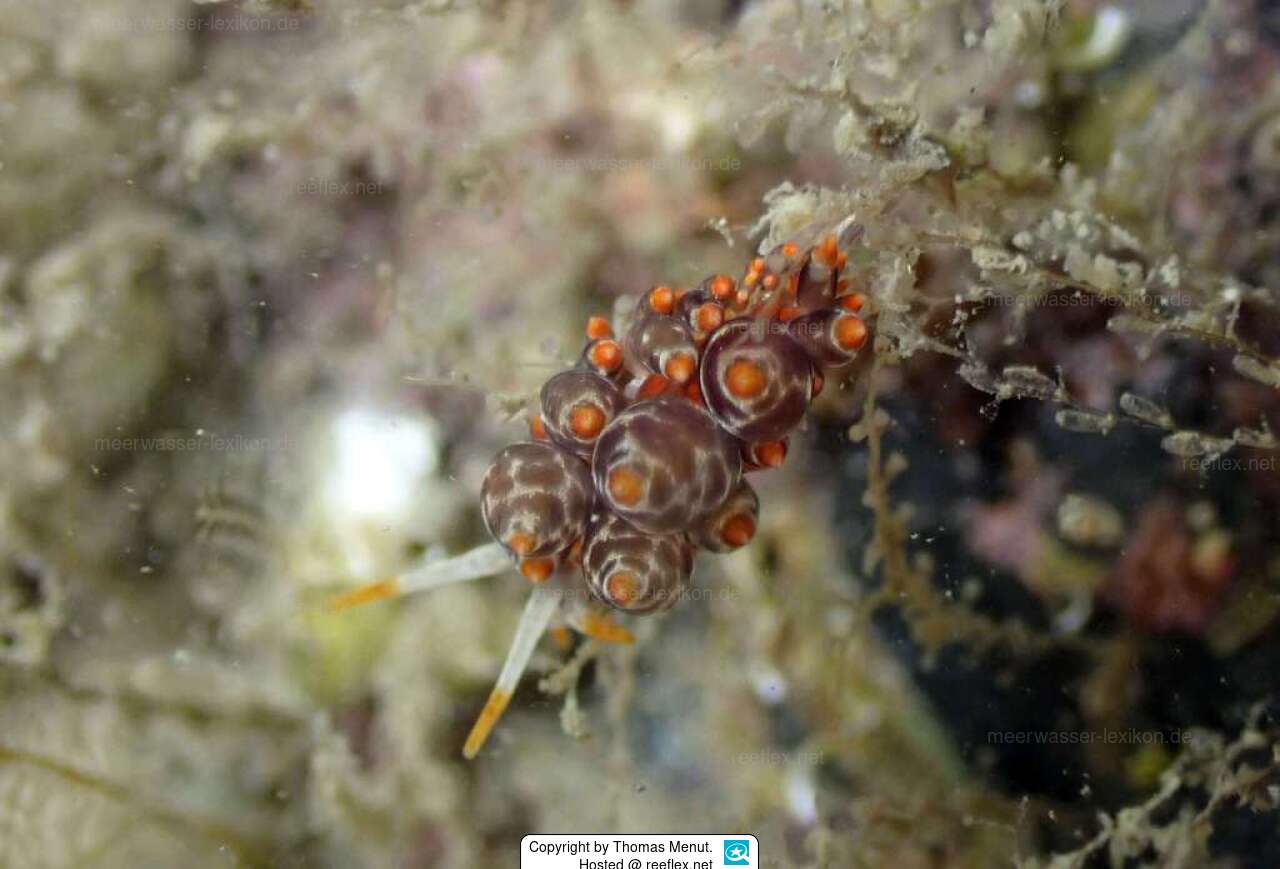
 Thomas Menut, Frankreich


Info
Amphorina andra Korshunova, Malmberg, Prkić, Petani, Fletcher, Lundin & Martynov, 2020
Amphorina andra was recently separated from the species Amphorina farrani. The species are difficult to distinguish from one another, but although both have yellow pigmentation that can vary widely, there are color differences between species.
The species was originally described from specimens found from the west coast of Sweden, the British Isles, and Italy and Croatia in the Mediterranean. Amphorina andrain has been recorded along the Norwegian coast in Egersund, Gülen in the Sognefjord and Kvaløyvågen in Troms.
Amphorina andra grows up to 20 mm long. The dorsal side has up to 7 diagonal rows of inflated cerata with up to 3 cerata in each row. The digestive gland is thick but does not form branches. The rinophores are almost twice as long as the mouth tentacles. The foot is slim.
The ground body color is gray-white mostly with yellow or orange pigmentation, which occurs as large patches on the body and covers the tips of the cerata, rhinophores and mouth tentacles, but the yellow stripe on the tip of the tail is absent. The digestive gland is white to light yellowish-brown.
There are several color variations of this species, from those with an almost completely pale body without pigmentation to variants with prominent yellow and orange pigmentation on the body, cerata, rhinophores and mouth tentacles. However, it lacks yellow and orange pigmentation on the tail, although a white stripe may be visible. A color variant of Amphorina andra is characterized by the presence of dark brown to black pigment spots on the body and cerata.
Amphorina andra has been found in shallow water up to 30 meters deep. No observations have been made as to what type of hydrozoan it feeds on.
It is not yet known what the egg mass of this species looks like or when the eggs are laid. The closely related Amphorina farrani lays a white egg band with a diameter of about 1-2 cm in a circle of 1-2 turns on its edge.
Amphorina andra differs from Amphorina farrani in that it lacks yellow pigmentation on the tail, while Amphorina farrani has yellow pigmentation on the tail. It may also resemble Amphorina linensis, but does not have white pigmentation along the edge of the foot. Amphorina andra may also resemble Amphorina viriola but lacks the pink pigmentation beneath the tip of the cerata.
The genus name "Amphorina" is derived from the Greek term for amphora, which is an oval vessel. The name refers to the inflated cerata on the dorsal side of the genus, which often have such a shape.
The species name "andra" comes from Swedish and means "the other" and refers to the close relationship with the species Amphorina viriola.
Amphorina andra was recently separated from the species Amphorina farrani. The species are difficult to distinguish from one another, but although both have yellow pigmentation that can vary widely, there are color differences between species.
The species was originally described from specimens found from the west coast of Sweden, the British Isles, and Italy and Croatia in the Mediterranean. Amphorina andrain has been recorded along the Norwegian coast in Egersund, Gülen in the Sognefjord and Kvaløyvågen in Troms.
Amphorina andra grows up to 20 mm long. The dorsal side has up to 7 diagonal rows of inflated cerata with up to 3 cerata in each row. The digestive gland is thick but does not form branches. The rinophores are almost twice as long as the mouth tentacles. The foot is slim.
The ground body color is gray-white mostly with yellow or orange pigmentation, which occurs as large patches on the body and covers the tips of the cerata, rhinophores and mouth tentacles, but the yellow stripe on the tip of the tail is absent. The digestive gland is white to light yellowish-brown.
There are several color variations of this species, from those with an almost completely pale body without pigmentation to variants with prominent yellow and orange pigmentation on the body, cerata, rhinophores and mouth tentacles. However, it lacks yellow and orange pigmentation on the tail, although a white stripe may be visible. A color variant of Amphorina andra is characterized by the presence of dark brown to black pigment spots on the body and cerata.
Amphorina andra has been found in shallow water up to 30 meters deep. No observations have been made as to what type of hydrozoan it feeds on.
It is not yet known what the egg mass of this species looks like or when the eggs are laid. The closely related Amphorina farrani lays a white egg band with a diameter of about 1-2 cm in a circle of 1-2 turns on its edge.
Amphorina andra differs from Amphorina farrani in that it lacks yellow pigmentation on the tail, while Amphorina farrani has yellow pigmentation on the tail. It may also resemble Amphorina linensis, but does not have white pigmentation along the edge of the foot. Amphorina andra may also resemble Amphorina viriola but lacks the pink pigmentation beneath the tip of the cerata.
The genus name "Amphorina" is derived from the Greek term for amphora, which is an oval vessel. The name refers to the inflated cerata on the dorsal side of the genus, which often have such a shape.
The species name "andra" comes from Swedish and means "the other" and refers to the close relationship with the species Amphorina viriola.


