


 ResearchGate


Info
New species from the animal and plant kingdoms are discovered and described every day, often after months of field research
This is the idealized, exploratory and adventurous approach, but the majority of species discoveries actually occur in the processing of collected specimens in a museum, according to Dr. Gustav M. Kessel of Victoria University of Wellington, Wellington, Aotearoa-New Zealand.
The soft coral Alcyonium aurantiacum, known as "Dead man's fingers", was one of the first corals to be scientifically described during the Astrolabe expeditions in New Zealand.
Typical of the time, the original description by Quoy & Gaimard is vague and based largely on features that have little diagnostic value by today's standards. The only other taxonomic treatment of Alcyonium aurantiacum is the description by Benham (1928), which unfortunately further obscures the diversity of New Zealand coastal soft corals by assigning both lobed and encrusting specimens to this coral.
Consequently, several morphologically distinct forms were identified as possibly belonging to Alcyonium aurantiacum, although they are highly variable in terms of color, colony shape and sclerite morphology.
Dr. Kessel took up this challenge and his work led to the first description of no less than 10 new species, all of which had previously been assigned to Alcyonium aurantiacum.
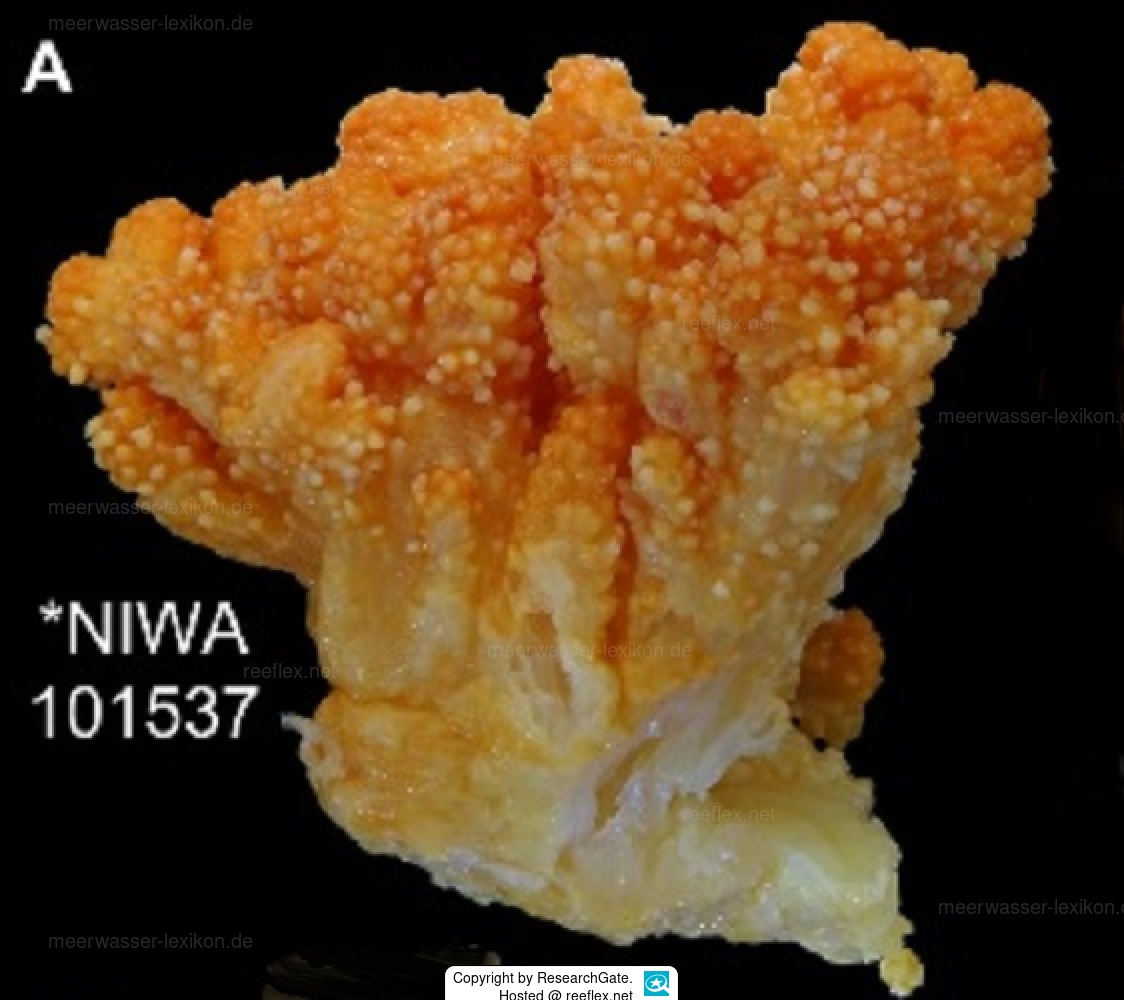
One of these new species is the soft coral Kotatea raekura
Diagnosis:
The colonies have branched lobes and are orange in color with white polyps.
The tentacles contain irregular, warty, scale-like sclerites. The polyp neck contains warty, rod-like forms. The polyp mounds contain thorny and warty clubs.
The lobe surface contains similar clubs as well as warty, belt-like, spindle-shaped forms.
The base surface contains thorny clubs, rays and spindle-shaped forms that are girdled with spines or warts. Lobes and the interior of the base contain irregular, branched, warty forms.
The holotype is a fragment of a larger colony and measures 6 cm in height and 6 cm in width.
It is orange in color (preserved with ethanol) and fades towards the base. The polyps are white, 0.5 - 1 mm in size when expanded.
They occur all over the lobes, but are densest at the tips and absent at the base, which is ~2 cm in size
Etymology
The species name was composed by the Ngāti Kurī Tira Me Te Wā Taiao (Science) Collective and is a combination of the Māori words rae, forehead or ancient, cherished thought, and kura, which can mean red, but can also mean red feathers, which can mean decoration, treasure, sacred or valuable possession, divine law philosophy and chieftain. Ngāti Kurī provided the following kōrero (narrative): "The forehead, the brain,
is the place where all pure thoughts arise and are stored. Knowledge is passed on through wānanga (tribal knowledge and knowledge and learning). Our mātauranga (knowledge) exists in both the visible and invisible universe.
The taiao (natural world) tells us that we are merely custodians of a delicate balance of ecosystems.
We must constantly create sustainable options to secure the future. We must listen to the voice
of Papatūānuku (Earth Mother). The orange crown at the top of Raekura's polyp symbolizes Te Ōpuawānanga (the flowering of knowledge), which is prevalent in the teachings of our tūpuna (ancestors).
We must continue to strive to attain new knowledge while holding on to our old knowledge. Raekura explores the many dimensions of acquiring knowledge. Many iwi and hapū (tribes and sub-tribes) have their own complementary mātauranga. Dr. Rangi Matamua of Tūhoe was given a manuscript by his grandfather to share the astronomical knowledge that was passed down from their tūpuna Te Kokau Himiona TePikikotuku and his son Rawiri Te Kokau in the 19th century. His grandfather said these wise words:
'Knowledge that is not shared is not knowledge.
Etymology:
Kotatea is the Māori word for red soft coral and is used as a generic name to honor their original te reo (Māori language) names. Ko refers to a distant point in time, while tatea means descendants. Furthermore, kota (hardened shell) refers to the substrate on which some colonies grow, while tea (white) refers to the polyps that collectively cling to this foundation, signifying whānau (family), unity and security. Ngāti Kurī deliberated on the appropriateness of this name and provided the following kōrero (narrative): "Kotatea is all about whānau (family)
All known specimens come from shallow depths (-11 m) near the Manawatāwhi/Three Kings Islands, New Zealand.
Literature reference:
Kessel, Gustav M., Alderslade, Philip, Bilewitch, Jaret P., Schnabel, Kareen E., Norman, Jerry, Potts, Romana Tekaharoa, Gardner, Jonathan P.A. (2022):
Dead man's fingers point to new taxa: two new genera of New Zealand soft corals (Anthozoa, Octocorallia) and a revision of Alcyonium aurantiacum Quoy & Gaimard, 1833
European Journal of Taxonomy 837: 1-85, DOI: https://doi.org/10.5852/ejt.2022.837.1923, URL: http://zoobank.org/7cbac71f-ff75-411c-9ce9-aa633e16438e
https://creativecommons.org/licenses/by/4.0/
This is the idealized, exploratory and adventurous approach, but the majority of species discoveries actually occur in the processing of collected specimens in a museum, according to Dr. Gustav M. Kessel of Victoria University of Wellington, Wellington, Aotearoa-New Zealand.
The soft coral Alcyonium aurantiacum, known as "Dead man's fingers", was one of the first corals to be scientifically described during the Astrolabe expeditions in New Zealand.
Typical of the time, the original description by Quoy & Gaimard is vague and based largely on features that have little diagnostic value by today's standards. The only other taxonomic treatment of Alcyonium aurantiacum is the description by Benham (1928), which unfortunately further obscures the diversity of New Zealand coastal soft corals by assigning both lobed and encrusting specimens to this coral.
Consequently, several morphologically distinct forms were identified as possibly belonging to Alcyonium aurantiacum, although they are highly variable in terms of color, colony shape and sclerite morphology.
Dr. Kessel took up this challenge and his work led to the first description of no less than 10 new species, all of which had previously been assigned to Alcyonium aurantiacum.
One of these new species is the soft coral Kotatea raekura
Diagnosis:
The colonies have branched lobes and are orange in color with white polyps.
The tentacles contain irregular, warty, scale-like sclerites. The polyp neck contains warty, rod-like forms. The polyp mounds contain thorny and warty clubs.
The lobe surface contains similar clubs as well as warty, belt-like, spindle-shaped forms.
The base surface contains thorny clubs, rays and spindle-shaped forms that are girdled with spines or warts. Lobes and the interior of the base contain irregular, branched, warty forms.
The holotype is a fragment of a larger colony and measures 6 cm in height and 6 cm in width.
It is orange in color (preserved with ethanol) and fades towards the base. The polyps are white, 0.5 - 1 mm in size when expanded.
They occur all over the lobes, but are densest at the tips and absent at the base, which is ~2 cm in size
Etymology
The species name was composed by the Ngāti Kurī Tira Me Te Wā Taiao (Science) Collective and is a combination of the Māori words rae, forehead or ancient, cherished thought, and kura, which can mean red, but can also mean red feathers, which can mean decoration, treasure, sacred or valuable possession, divine law philosophy and chieftain. Ngāti Kurī provided the following kōrero (narrative): "The forehead, the brain,
is the place where all pure thoughts arise and are stored. Knowledge is passed on through wānanga (tribal knowledge and knowledge and learning). Our mātauranga (knowledge) exists in both the visible and invisible universe.
The taiao (natural world) tells us that we are merely custodians of a delicate balance of ecosystems.
We must constantly create sustainable options to secure the future. We must listen to the voice
of Papatūānuku (Earth Mother). The orange crown at the top of Raekura's polyp symbolizes Te Ōpuawānanga (the flowering of knowledge), which is prevalent in the teachings of our tūpuna (ancestors).
We must continue to strive to attain new knowledge while holding on to our old knowledge. Raekura explores the many dimensions of acquiring knowledge. Many iwi and hapū (tribes and sub-tribes) have their own complementary mātauranga. Dr. Rangi Matamua of Tūhoe was given a manuscript by his grandfather to share the astronomical knowledge that was passed down from their tūpuna Te Kokau Himiona TePikikotuku and his son Rawiri Te Kokau in the 19th century. His grandfather said these wise words:
'Knowledge that is not shared is not knowledge.
Etymology:
Kotatea is the Māori word for red soft coral and is used as a generic name to honor their original te reo (Māori language) names. Ko refers to a distant point in time, while tatea means descendants. Furthermore, kota (hardened shell) refers to the substrate on which some colonies grow, while tea (white) refers to the polyps that collectively cling to this foundation, signifying whānau (family), unity and security. Ngāti Kurī deliberated on the appropriateness of this name and provided the following kōrero (narrative): "Kotatea is all about whānau (family)
All known specimens come from shallow depths (-11 m) near the Manawatāwhi/Three Kings Islands, New Zealand.
Literature reference:
Kessel, Gustav M., Alderslade, Philip, Bilewitch, Jaret P., Schnabel, Kareen E., Norman, Jerry, Potts, Romana Tekaharoa, Gardner, Jonathan P.A. (2022):
Dead man's fingers point to new taxa: two new genera of New Zealand soft corals (Anthozoa, Octocorallia) and a revision of Alcyonium aurantiacum Quoy & Gaimard, 1833
European Journal of Taxonomy 837: 1-85, DOI: https://doi.org/10.5852/ejt.2022.837.1923, URL: http://zoobank.org/7cbac71f-ff75-411c-9ce9-aa633e16438e
https://creativecommons.org/licenses/by/4.0/

