

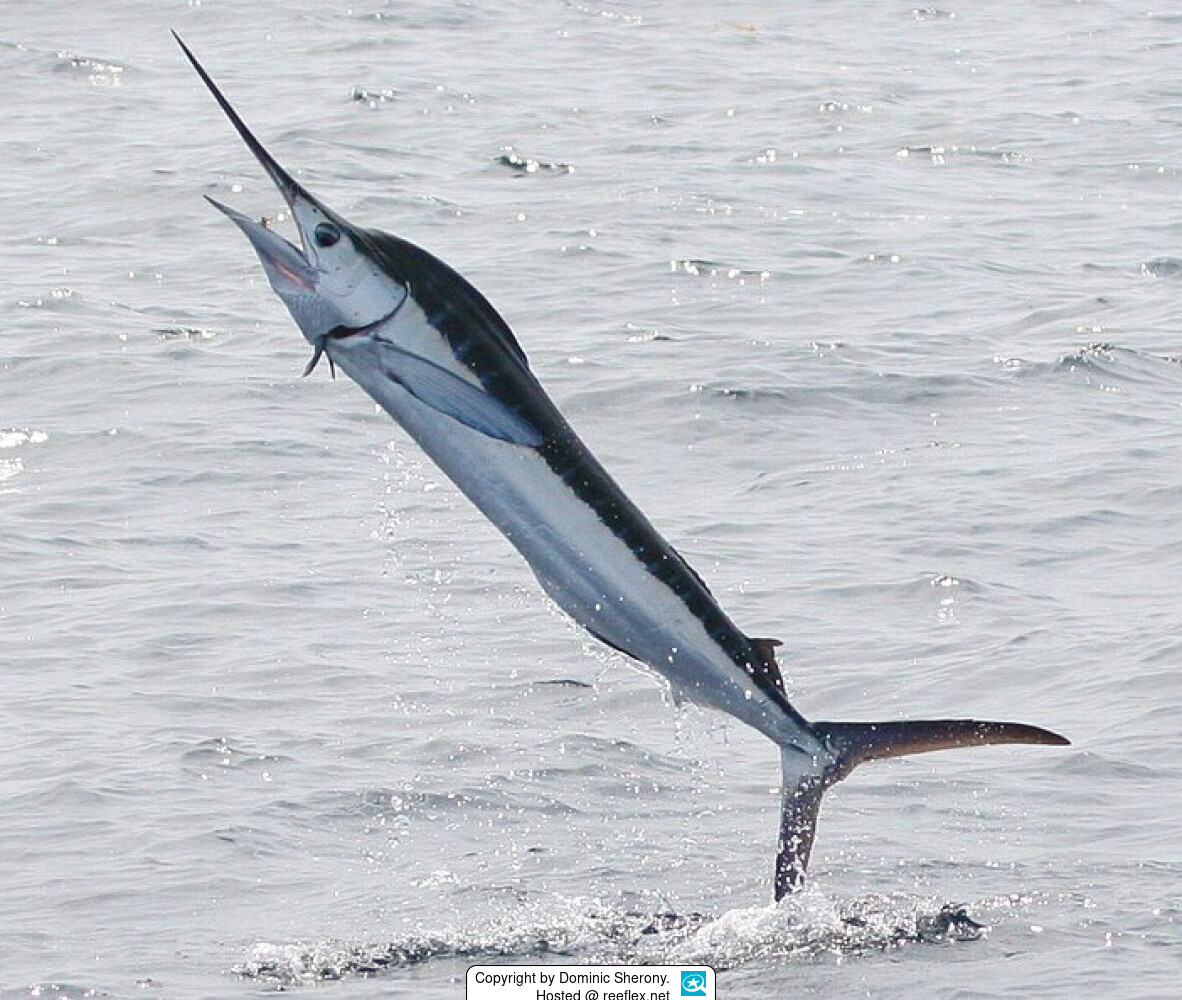
 Dominic Sherony, USA


Info
The white marlin is an extremely elegant and super-fast hunter of the seas. Depending on the source, it can reach top speeds of 64 to 128 km/h.
To give you a comparison, we looked up the top speed of the Queen Mary 2, which is 56 kilometers per hour!
Even if the white marlin cannot match the top speeds of speedboats, it should be clear that it can easily catch any fleeing prey fish.
In addition to cephalopods, the white marlin's diet consists mainly of fish such as mackerel, herring, flying fish, and small tuna such as bonito.
The Florida Museum states that even (small) dolphins are said to be prey of the white marlin.
The pelagic and oceanodromous apex predator is said to stun or kill its prey by impaling or slitting it with its beak, but no fish caught by impaling or slitting could be found in samples.
It is therefore more likely that the marlin stuns its prey by striking it with its long beak and then eats it.
Results from studies using pop-up satellite archiving tags show that it spends most of its time in the upper 20 meters of the water column and at temperatures within a few degrees of the surface temperature.
It spends more than 95% of its time at depths of less than 100 meters at temperatures within 8°C of the surface temperature.
Vertical excursions, presumably for feeding, occur at depths below the thermocline and have been observed at depths of up to almost 400 m (Prince et al. 2005, IGFA 2013). Throughout the western North Atlantic, habitat use varies by area, with fish in waters with a shallow thermocline tending to be more surface-oriented.
Currently available information suggests that white marlin spawn once a year. Knowledge of spawning times, spawning areas, and mating behavior is incomplete due to the difficulty of identifying eggs and larvae and the lack of continuous and comprehensive studies on gonads and ichthyoplankton. White marlin migrate to subtropical waters to spawn, with the peak spawning season occurring in early summer in both the western North Atlantic and western South Atlantic (Ueyanagi et al. 1970). Spawning grounds are located in deep, blue waters, usually at high temperatures between 24 and 29 °C, with the exception of the South Atlantic eddies, and high surface salinity (above 35 ppt).
Earlier reports mention spawning in the same area where blue marlin spawn in April and May in the Mona Passage (Prince et al. 2005), as well as off the southeast coast of Brazil, but later in the year, from April to June.
Off the south coast of Brazil (25–26°S and 40–45°W), white marlin spawn from December to March. In the northwest Atlantic, white marlin reproduction has been reported in June in the Gulf of Mexico (Rooker et al. 2012).
There is no obvious sexual dimorphism in white marlin, but females reach a larger size than males.
The age of white marlin between 1 and 13 years was estimated by counting the annual rings on the anal fin spines (Die and Drew 2008, Drew et al. 2006).
Life expectancy based on the maximum time in freedom for fish tagged with conventional tags is estimated at 15 years (Ortiz et al. 2003).
Lucena-Fredóu and Asano-Filho (2006) found individuals with a length of 153 to 290 cm (upper jaw length (UJFL)) on the northern coast of Brazil.
The 290 cm long animal is the largest specimen recorded to date, weighing 120 kg.
The IGFA world record for all fishing gear is a fish weighing 181 lb, 14 oz (82.50 kg), caught off Vitoria, Brazil, in December 1979 (IGFA 2020).
Its distribution varies seasonally and only reaches higher latitudes in both the northern and southern hemispheres during the respective warm seasons.
Kajikia albida is a sport fish whose catch not only raises the blood pressure of sport anglers and provides an extremely exhausting fight, but can also pose a danger to sport fishermen.
White marlin are capable of leaping up to 3 meters out of the water, and there are credible reports of deep-sea anglers suffering serious injuries to their chest, head, and legs from the sword of highly stressed marlin, for example in the Gulf of Mexico.
What few people know, however, is that these fast animals have an extremely high mortality rate, dying in gillnets or as bycatch.
The meat of the white marlin is of excellent quality and is sold fresh and frozen.
Synonyms:
Lamontella albida (Poey, 1860) · unaccepted
Makaira albida (Poey, 1860) · unaccepted
Makaira lessonae (Canestrini, 1861) · unaccepted
Tetrapterus albidus Poey, 1860 · unaccepted (misspelling)
Tetrapturus albidus Poey, 1860 · unaccepted
Tetrapturus lessonae Canestrini, 1861 · unaccepted Meters
To give you a comparison, we looked up the top speed of the Queen Mary 2, which is 56 kilometers per hour!
Even if the white marlin cannot match the top speeds of speedboats, it should be clear that it can easily catch any fleeing prey fish.
In addition to cephalopods, the white marlin's diet consists mainly of fish such as mackerel, herring, flying fish, and small tuna such as bonito.
The Florida Museum states that even (small) dolphins are said to be prey of the white marlin.
The pelagic and oceanodromous apex predator is said to stun or kill its prey by impaling or slitting it with its beak, but no fish caught by impaling or slitting could be found in samples.
It is therefore more likely that the marlin stuns its prey by striking it with its long beak and then eats it.
Results from studies using pop-up satellite archiving tags show that it spends most of its time in the upper 20 meters of the water column and at temperatures within a few degrees of the surface temperature.
It spends more than 95% of its time at depths of less than 100 meters at temperatures within 8°C of the surface temperature.
Vertical excursions, presumably for feeding, occur at depths below the thermocline and have been observed at depths of up to almost 400 m (Prince et al. 2005, IGFA 2013). Throughout the western North Atlantic, habitat use varies by area, with fish in waters with a shallow thermocline tending to be more surface-oriented.
Currently available information suggests that white marlin spawn once a year. Knowledge of spawning times, spawning areas, and mating behavior is incomplete due to the difficulty of identifying eggs and larvae and the lack of continuous and comprehensive studies on gonads and ichthyoplankton. White marlin migrate to subtropical waters to spawn, with the peak spawning season occurring in early summer in both the western North Atlantic and western South Atlantic (Ueyanagi et al. 1970). Spawning grounds are located in deep, blue waters, usually at high temperatures between 24 and 29 °C, with the exception of the South Atlantic eddies, and high surface salinity (above 35 ppt).
Earlier reports mention spawning in the same area where blue marlin spawn in April and May in the Mona Passage (Prince et al. 2005), as well as off the southeast coast of Brazil, but later in the year, from April to June.
Off the south coast of Brazil (25–26°S and 40–45°W), white marlin spawn from December to March. In the northwest Atlantic, white marlin reproduction has been reported in June in the Gulf of Mexico (Rooker et al. 2012).
There is no obvious sexual dimorphism in white marlin, but females reach a larger size than males.
The age of white marlin between 1 and 13 years was estimated by counting the annual rings on the anal fin spines (Die and Drew 2008, Drew et al. 2006).
Life expectancy based on the maximum time in freedom for fish tagged with conventional tags is estimated at 15 years (Ortiz et al. 2003).
Lucena-Fredóu and Asano-Filho (2006) found individuals with a length of 153 to 290 cm (upper jaw length (UJFL)) on the northern coast of Brazil.
The 290 cm long animal is the largest specimen recorded to date, weighing 120 kg.
The IGFA world record for all fishing gear is a fish weighing 181 lb, 14 oz (82.50 kg), caught off Vitoria, Brazil, in December 1979 (IGFA 2020).
Its distribution varies seasonally and only reaches higher latitudes in both the northern and southern hemispheres during the respective warm seasons.
Kajikia albida is a sport fish whose catch not only raises the blood pressure of sport anglers and provides an extremely exhausting fight, but can also pose a danger to sport fishermen.
White marlin are capable of leaping up to 3 meters out of the water, and there are credible reports of deep-sea anglers suffering serious injuries to their chest, head, and legs from the sword of highly stressed marlin, for example in the Gulf of Mexico.
What few people know, however, is that these fast animals have an extremely high mortality rate, dying in gillnets or as bycatch.
The meat of the white marlin is of excellent quality and is sold fresh and frozen.
Synonyms:
Lamontella albida (Poey, 1860) · unaccepted
Makaira albida (Poey, 1860) · unaccepted
Makaira lessonae (Canestrini, 1861) · unaccepted
Tetrapterus albidus Poey, 1860 · unaccepted (misspelling)
Tetrapturus albidus Poey, 1860 · unaccepted
Tetrapturus lessonae Canestrini, 1861 · unaccepted Meters

