

 Sylvain Le Bris, Frankreich


Info
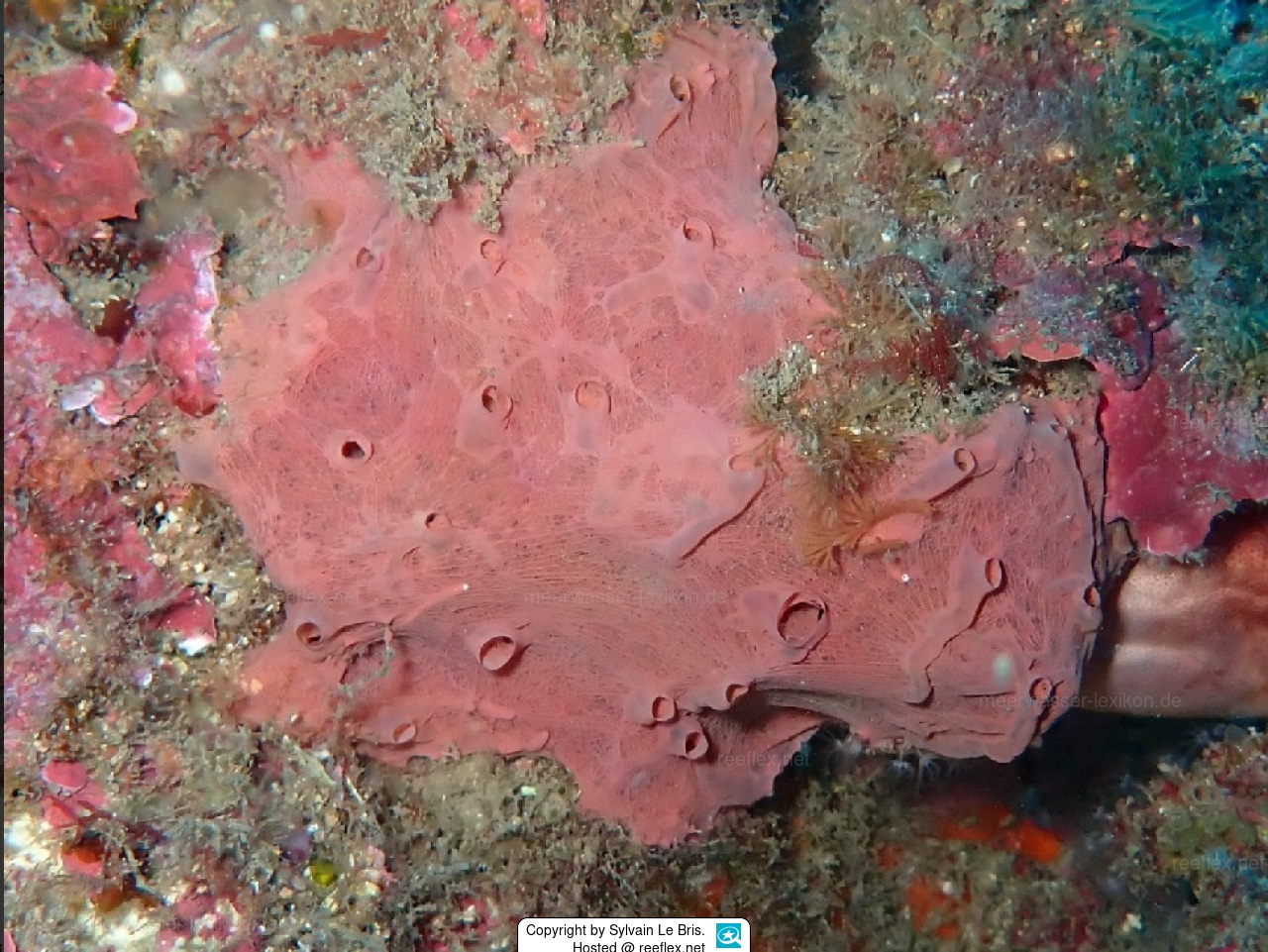
The sea sponge Hexadella topsenti has a smooth, striped surface with several small, chimney-like protrusions that converge towards the osculum and are connected by a network of thin ribs.
The sea sponge contains spherical cells with large inclusions that contain microgranules and microgranular cells.
No foreign bodies were found on the surface of the marine sponges examined.
The pores are microscopically small and the oscula are numerous, scattered and resemble small chimneys, as they are the extension of membrane-like surface channels.
The sponge has a thin crust with a lobular body.
Toxicity: Low to moderate natural toxicity.
Colour: Hexadella topsenti is light to dark pink and even violet in colour.
Information on the size of this sea sponge was not recorded in the initial description.
Etymology
The species is dedicated to the French zoologist and former curator at the Zoological Museum in Strasbourg, Émile Topsent (1862–1951), who first described the genus Hexadella.
Several sponge species are named after Émile Topsent, including:
Acheliderma topsenti Burton, 1932, Axinyssa topsenti Lendenfeld, 1897, Chondropsis topsenti Dendy, 1895, Corticium topsenti Pouliquen, 1972, Cryptotethya topsenti Thiele, 1900, Desmacella topsenti Burton, 1930, Desmanthus topsenti Hentschel, 1912, Dragmatyle topsenti Burton, 195, Dysideopsis topsenti Hentschel, 1912, Echinodictyum topsenti De Laubenfels, 1936, Erylus topsenti von Lendenfeld, 1903, Eurypon topsenti Pulitzer-Finali, 1983, Grayella topsenti Babic, 1922, Haddonella topsenti I. Sollas, 1903
Halichondria topsenti De Laubenfels, 1936, Hymenotrocha topsenti Burton, 1930, Hymerhabdia topsenti Lévi, 1952, Jaspis topsenti Thiele, 1900, Leucandra topsenti Reitfuss, 1929, Raspailia topsenti Dendy, 1924, Reniera topsenti Thiele, 1905, Rhabderemia topsenti Van Soest & Hooper, 1993, Rhabdoploca topsenti Hentschel, 1912, Spongosorites topsenti Dendy, 1905, Stelletta topsenti Thiele, 1903, Suberella topsenti Burton, 1929, Tedania topsenti De Laubenfels, 1930, Tylaspis topsenti Lévi & Lévi, 1983, Crella topsenti Babiç, 1922, Aristias topsenti Chevreux, 1900, Thoracactis topsenti Gravier C., 1918
The sea sponge contains spherical cells with large inclusions that contain microgranules and microgranular cells.
No foreign bodies were found on the surface of the marine sponges examined.
The pores are microscopically small and the oscula are numerous, scattered and resemble small chimneys, as they are the extension of membrane-like surface channels.
The sponge has a thin crust with a lobular body.
Toxicity: Low to moderate natural toxicity.
Colour: Hexadella topsenti is light to dark pink and even violet in colour.
Information on the size of this sea sponge was not recorded in the initial description.
Etymology
The species is dedicated to the French zoologist and former curator at the Zoological Museum in Strasbourg, Émile Topsent (1862–1951), who first described the genus Hexadella.
Several sponge species are named after Émile Topsent, including:
Acheliderma topsenti Burton, 1932, Axinyssa topsenti Lendenfeld, 1897, Chondropsis topsenti Dendy, 1895, Corticium topsenti Pouliquen, 1972, Cryptotethya topsenti Thiele, 1900, Desmacella topsenti Burton, 1930, Desmanthus topsenti Hentschel, 1912, Dragmatyle topsenti Burton, 195, Dysideopsis topsenti Hentschel, 1912, Echinodictyum topsenti De Laubenfels, 1936, Erylus topsenti von Lendenfeld, 1903, Eurypon topsenti Pulitzer-Finali, 1983, Grayella topsenti Babic, 1922, Haddonella topsenti I. Sollas, 1903
Halichondria topsenti De Laubenfels, 1936, Hymenotrocha topsenti Burton, 1930, Hymerhabdia topsenti Lévi, 1952, Jaspis topsenti Thiele, 1900, Leucandra topsenti Reitfuss, 1929, Raspailia topsenti Dendy, 1924, Reniera topsenti Thiele, 1905, Rhabderemia topsenti Van Soest & Hooper, 1993, Rhabdoploca topsenti Hentschel, 1912, Spongosorites topsenti Dendy, 1905, Stelletta topsenti Thiele, 1903, Suberella topsenti Burton, 1929, Tedania topsenti De Laubenfels, 1930, Tylaspis topsenti Lévi & Lévi, 1983, Crella topsenti Babiç, 1922, Aristias topsenti Chevreux, 1900, Thoracactis topsenti Gravier C., 1918

