





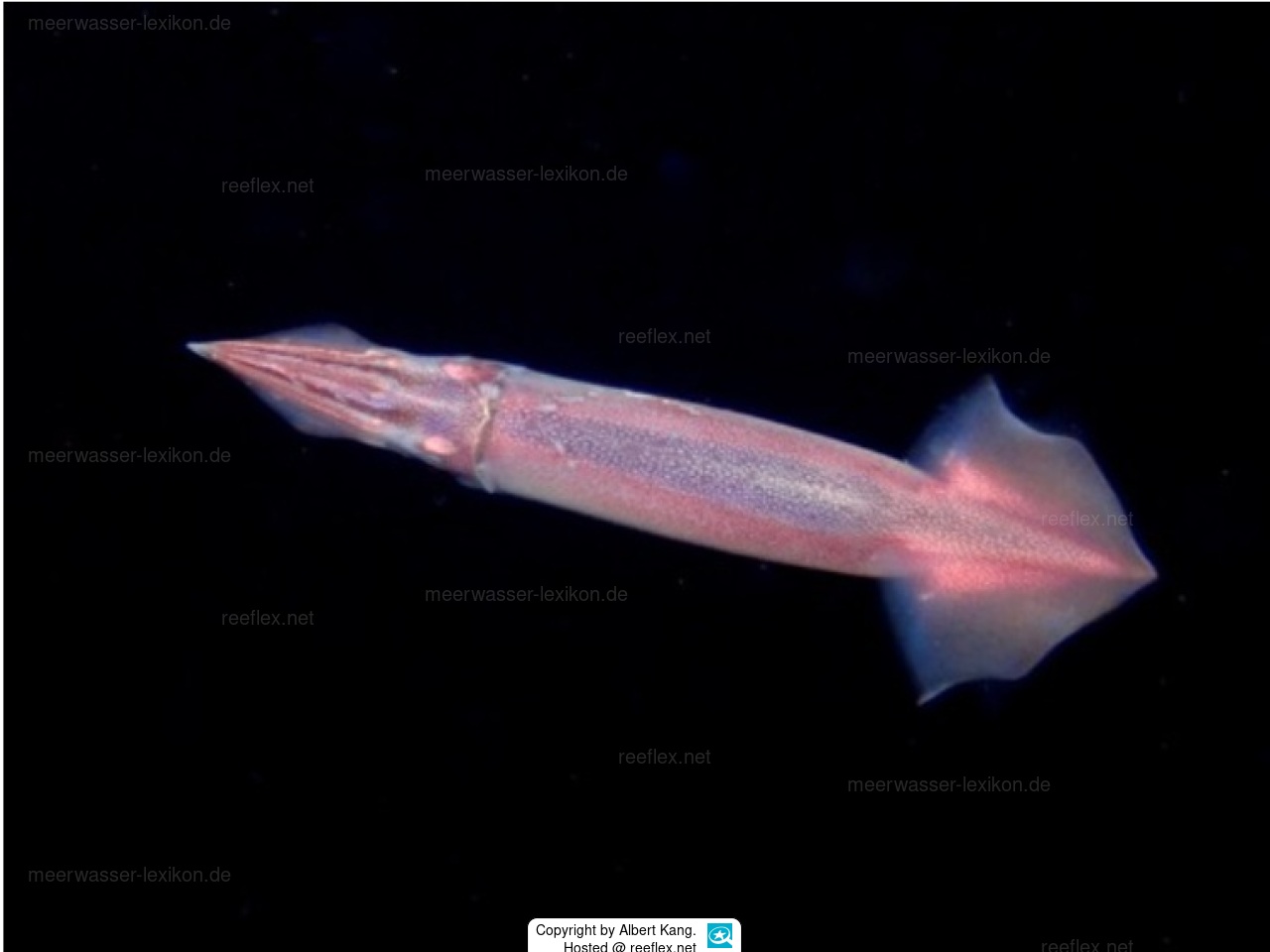
 Albert Kang, Philippinen

Info
Todarodes pacificus ai an oceanic and neritic species found in waters with temperatures up to 27 °C, typically in surface waters down to a depth of 100 meters and, to a lesser extent, down to a depth of 500 meters.
During its lifespan of about one year, a northward migration occurs first, followed by a further southward migration, which is generally closely linked to changes in major surface currents.
Large aggregations of the species occur in small eddies and along oceanic fronts.
In Japanese waters, three independently spawning subpopulations can be distinguished.
The main group spawns in winter in the East China Sea, the second in autumn west of Kyushu, and the third, smaller group in spring/summer in the Sea of Japan and off the northeast coast of Japan.
Post-spawning mortality is very high, as is the case with many cephalopods.
Todarodes pacificus is commercially fished, as the squid is a sought-after food item.
Nature, however, has devised something quite special for this swift predator, as the squid is preyed upon not only by humans but also by larger marine predators.
Large mackerel and tuna also reach high speeds when hunting; to escape these voracious predators, Todarodes pacificus is able to briefly escape the water:
The squid expels water at high pressure from its mantle cavity (jet propulsion), thereby breaking through the water’s surface; it then spreads its fins and arms to glide and, under favorable conditions, can “fly through the air” for up to 50 meters.
Sometimes the predators are so confused by this special maneuver that they abandon the chase.
Synonyme:
Ommastrephes pacificus Steenstrup, 1880 · unaccepted (original combination)
Ommatostrephes pacificus Steenstrup, 1880 · unaccepted (original combination)
Todarodes pacificus pacificus Steenstrup, 1880 · unaccepted
During its lifespan of about one year, a northward migration occurs first, followed by a further southward migration, which is generally closely linked to changes in major surface currents.
Large aggregations of the species occur in small eddies and along oceanic fronts.
In Japanese waters, three independently spawning subpopulations can be distinguished.
The main group spawns in winter in the East China Sea, the second in autumn west of Kyushu, and the third, smaller group in spring/summer in the Sea of Japan and off the northeast coast of Japan.
Post-spawning mortality is very high, as is the case with many cephalopods.
Todarodes pacificus is commercially fished, as the squid is a sought-after food item.
Nature, however, has devised something quite special for this swift predator, as the squid is preyed upon not only by humans but also by larger marine predators.
Large mackerel and tuna also reach high speeds when hunting; to escape these voracious predators, Todarodes pacificus is able to briefly escape the water:
The squid expels water at high pressure from its mantle cavity (jet propulsion), thereby breaking through the water’s surface; it then spreads its fins and arms to glide and, under favorable conditions, can “fly through the air” for up to 50 meters.
Sometimes the predators are so confused by this special maneuver that they abandon the chase.
Synonyme:
Ommastrephes pacificus Steenstrup, 1880 · unaccepted (original combination)
Ommatostrephes pacificus Steenstrup, 1880 · unaccepted (original combination)
Todarodes pacificus pacificus Steenstrup, 1880 · unaccepted

