


 Ella McCausland, England


Info
While researching Rhizostoma octopus, we noticed several inconsistencies and ambiguities:
Size:
Depending on the source, maximum size estimates vary between 50 cm, 60 cm, and 90 cm.
Distribution:
The majority of scientific sources cite the northeastern Atlantic; some sources mention occurrences in the Red Sea and the Indian Ocean.
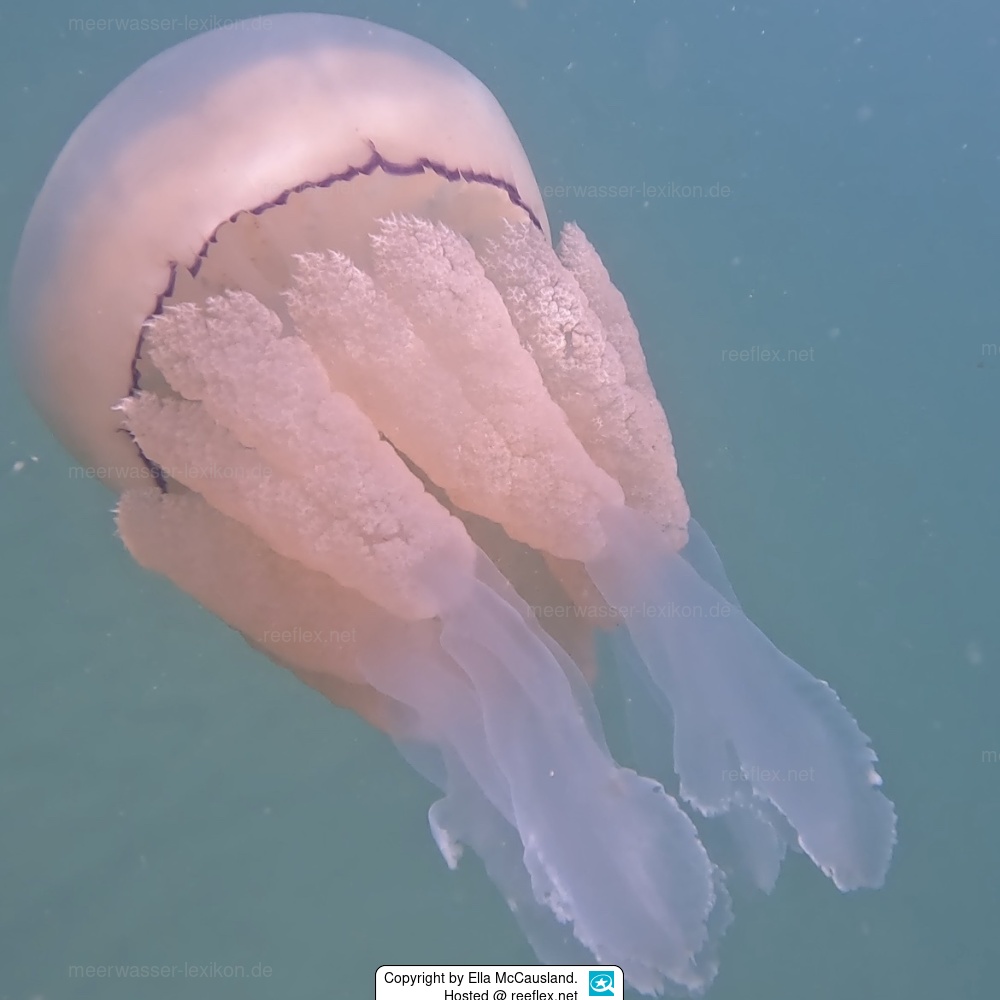
Particularly regarding the reported occurrences in the Indian Ocean, confusion with Rhizostoma pulmo is conceivable.Rhizostoma octopus has a smooth and somewhat flattened umbrella (also called a bell), which can reach a diameter of up to 90 cm.It is usually white or bluish, but can also be red, brown, or gray, as well as a dirty-yellow color with violet lobes at the edge.The blue coloration of the ring muscle of the dorsal hood can help distinguish it from closely related species.
Below the hood is a manubrium bearing four pairs of oral arms.The oral arms are longer than the bell’s diameter and end in three-lobed tubercles that are wider at their tips.The edge of the bell features 112 rounded lobes, and the inner veil bears six pairs of veil lobes.There are no marginal tentacles.
Beneath its bell, the barrel jellyfish has hundreds of tiny openings (pores) that lead to a highly branched digestive system.Each opening is surrounded by tiny, stinging tentacles.The sting of the stinging cells is not strong enough to harm humans, but only affects plankton small enough to enter their tiny openings.
The scientific press has reported mass occurrences in the Bay of Biscay, France, and mass strandings in Texel in the Dutch Wadden Sea.
Predator: Leatherback turtle
Rhizostoma octopus is farmed in aquaculture to meet the growing demand for collagen, among other things, for skin care products.
Synonymised names
Cassiopea Borlase Péron & Lesueur, 1810 · unaccepted (synonym)
Medusa octopus Gmelin, 1791 · unaccepted (synonym)
Rhizostoma cuvieri Péron & Lesueur, 1810 · unaccepted (synonym)
Size:
Depending on the source, maximum size estimates vary between 50 cm, 60 cm, and 90 cm.
Distribution:
The majority of scientific sources cite the northeastern Atlantic; some sources mention occurrences in the Red Sea and the Indian Ocean.
Particularly regarding the reported occurrences in the Indian Ocean, confusion with Rhizostoma pulmo is conceivable.Rhizostoma octopus has a smooth and somewhat flattened umbrella (also called a bell), which can reach a diameter of up to 90 cm.It is usually white or bluish, but can also be red, brown, or gray, as well as a dirty-yellow color with violet lobes at the edge.The blue coloration of the ring muscle of the dorsal hood can help distinguish it from closely related species.
Below the hood is a manubrium bearing four pairs of oral arms.The oral arms are longer than the bell’s diameter and end in three-lobed tubercles that are wider at their tips.The edge of the bell features 112 rounded lobes, and the inner veil bears six pairs of veil lobes.There are no marginal tentacles.
Beneath its bell, the barrel jellyfish has hundreds of tiny openings (pores) that lead to a highly branched digestive system.Each opening is surrounded by tiny, stinging tentacles.The sting of the stinging cells is not strong enough to harm humans, but only affects plankton small enough to enter their tiny openings.
The scientific press has reported mass occurrences in the Bay of Biscay, France, and mass strandings in Texel in the Dutch Wadden Sea.
Predator: Leatherback turtle
Rhizostoma octopus is farmed in aquaculture to meet the growing demand for collagen, among other things, for skin care products.
Synonymised names
Cassiopea Borlase Péron & Lesueur, 1810 · unaccepted (synonym)
Medusa octopus Gmelin, 1791 · unaccepted (synonym)
Rhizostoma cuvieri Péron & Lesueur, 1810 · unaccepted (synonym)


