


 Sylvain Le Bris, Frankreich

Info
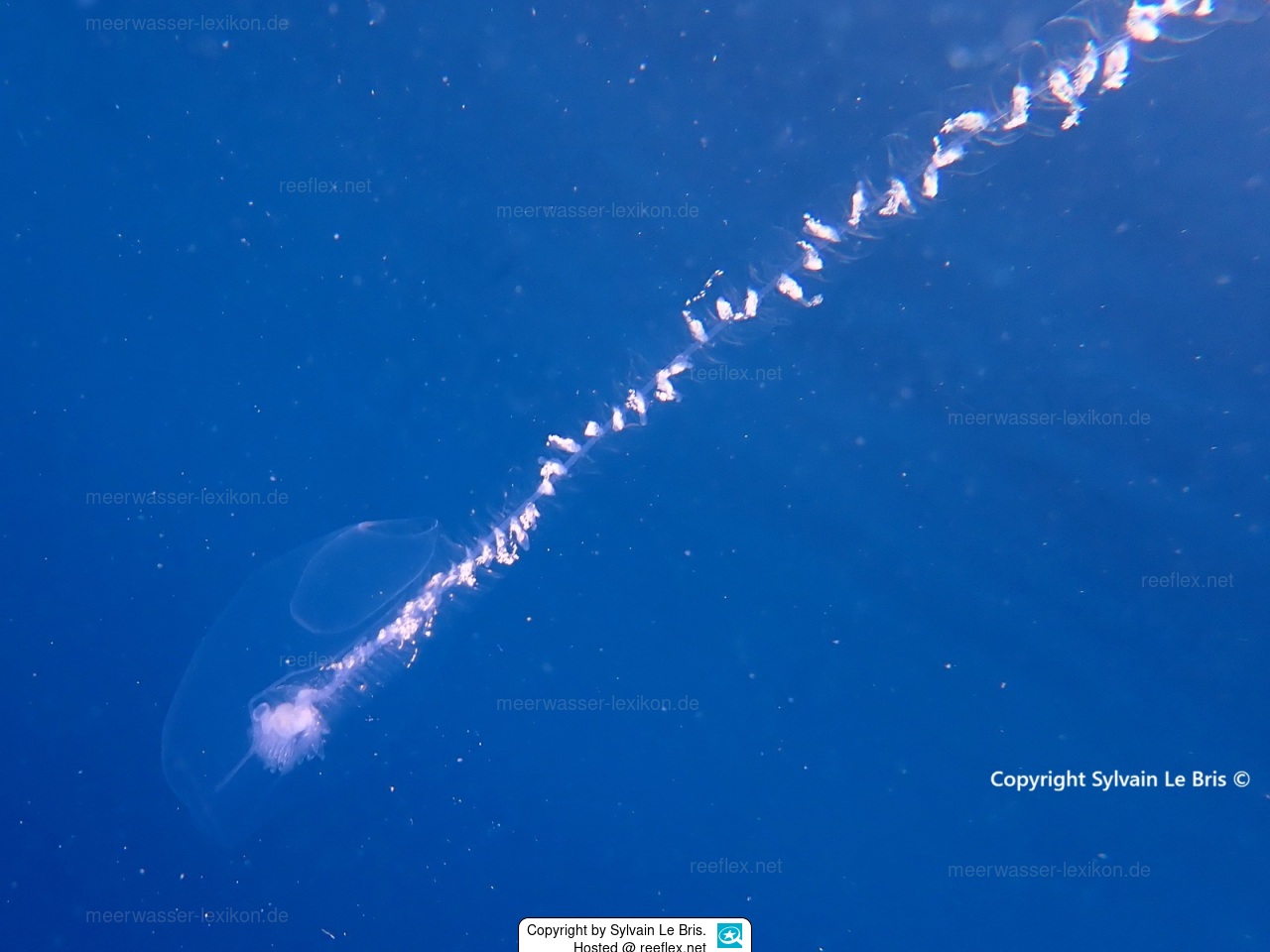
Siphonophores, including this species of state jellyfish, are colonial hydrozoans.
The colony consists of a variety of different zoids, each of which performs a specific function, such as capturing prey, locomotion, or reproduction. When swimming, the two swimming bells of different sizes at the tip of the colony pulsate.
The swimming bells often detach during growth but regrow quickly.
Rosacea cymbiformis is a large species whose colonies can reach lengths of over 3 meters and are sometimes visible from the surface.
Scientific analyses have shown that Rosacea cymbiformis feeds on copepods (58%) and crab zoea larvae (25%).
Synonyms:
Diphyes prayensis Quoy & Gaimard, 1833 · unaccepted (synonym)
Eudoxella didyma Haeckel, 1888 · unaccepted
Neorosacea cymbiformis (Delle Chiaje, 1830) · unaccepted (unaccepted combination)
Physalia cymbiformis Delle Chiaje, 1830 · unaccepted (basionym)
Praya californica Gravier, 1899 · unaccepted (synonym)
Praya diphyes Lesson, 1843 · unaccepted (synonym)
Praya maxima Gegenbaur, 1854 · unaccepted
The colony consists of a variety of different zoids, each of which performs a specific function, such as capturing prey, locomotion, or reproduction. When swimming, the two swimming bells of different sizes at the tip of the colony pulsate.
The swimming bells often detach during growth but regrow quickly.
Rosacea cymbiformis is a large species whose colonies can reach lengths of over 3 meters and are sometimes visible from the surface.
Scientific analyses have shown that Rosacea cymbiformis feeds on copepods (58%) and crab zoea larvae (25%).
Synonyms:
Diphyes prayensis Quoy & Gaimard, 1833 · unaccepted (synonym)
Eudoxella didyma Haeckel, 1888 · unaccepted
Neorosacea cymbiformis (Delle Chiaje, 1830) · unaccepted (unaccepted combination)
Physalia cymbiformis Delle Chiaje, 1830 · unaccepted (basionym)
Praya californica Gravier, 1899 · unaccepted (synonym)
Praya diphyes Lesson, 1843 · unaccepted (synonym)
Praya maxima Gegenbaur, 1854 · unaccepted

