

 Izuzuki Diver, Satoshi Yamamoto, Japan


Info
Very little information is currently available on this species.
Juveniles live in river estuaries, while adult fish leave these areas and live on sandy bottoms.
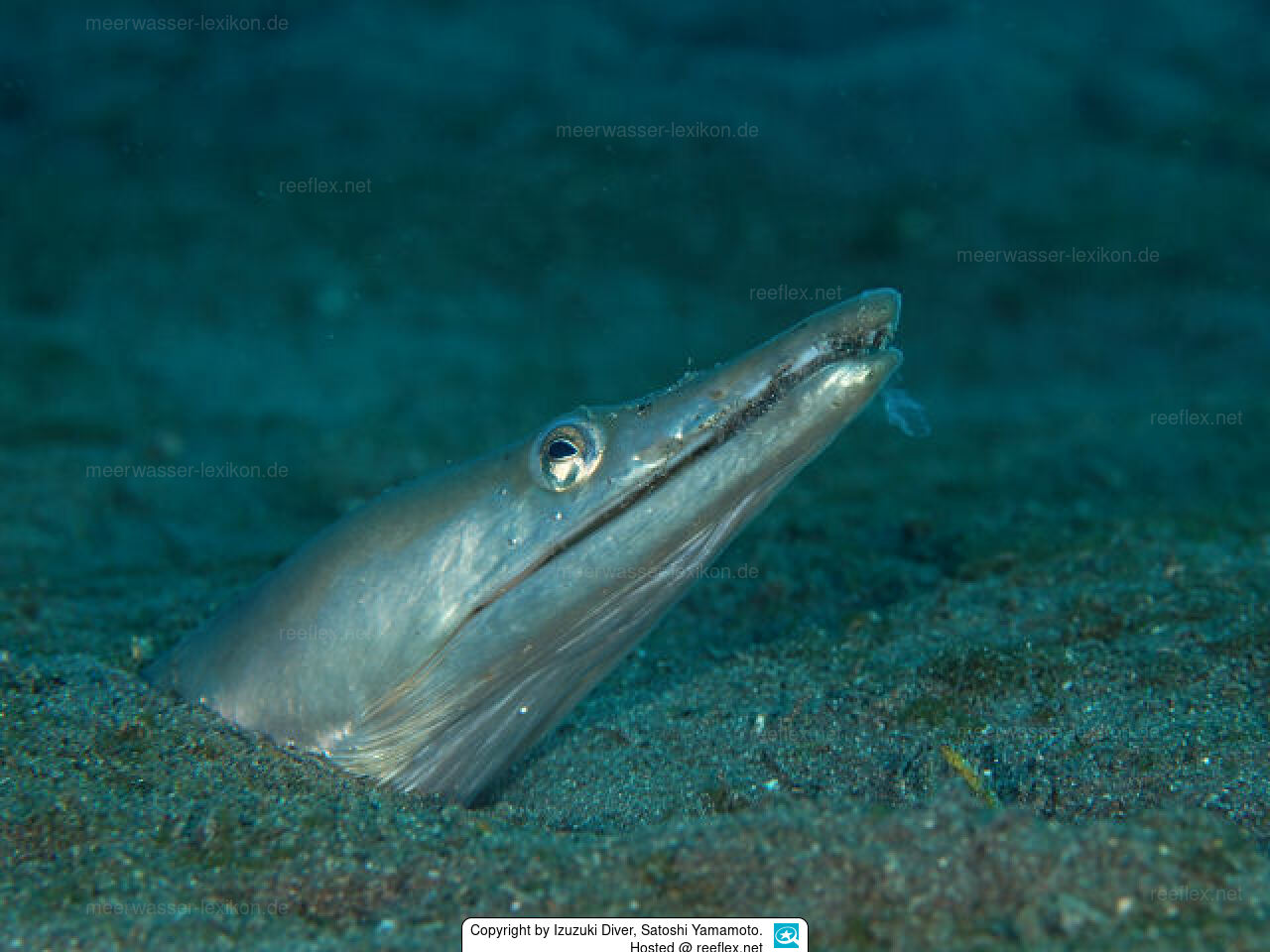
Ophisurus macrorhynchos has an elongated, slender, cylindrical body; its snout—which gives the species its name—is very long and tapers to a point.
The snake eel has no caudal fin.
Its dorsal fin originates toward the rear rather than directly above the tip of the pectoral fin; the dorsal and anal fins are low-set and have a very long base, and both fins end just before the tip of the tail.
The tip of the tail is hard, the mouth is large, and the rear end of the upper jaw extends beyond the rear edge of the eye.
The teeth of this carnivore are sharp, and there are fangs on both jaws as well as on the vomer.
The teeth: 1 row at the front of the upper jaw and on the vomer, 2 rows at the rear of the upper jaw, and 1 row on the lower jaw.
The gill opening is large. Several fleshy folds run vertically or horizontally across the entire body.
The base color is grayish-brown; the underside is silvery-white.
All fins are yellowish or brownish and thus perfectly camouflaged against the substrate.
Using its stiff tail, Ophisurus macrorhynchos burrows into the muddy bottom and slips backward into its burrow, tail first.
Ophisurus macrorhynchos is commercially fished and is also popular among sport fishermen; however, depending on the region, it is eaten as a food fish and is mainly consumed grilled.
Synonym: Ophisurus macrorhynchus Bleeker, 1853 · unaccepted (misspelling)
Juveniles live in river estuaries, while adult fish leave these areas and live on sandy bottoms.
Ophisurus macrorhynchos has an elongated, slender, cylindrical body; its snout—which gives the species its name—is very long and tapers to a point.
The snake eel has no caudal fin.
Its dorsal fin originates toward the rear rather than directly above the tip of the pectoral fin; the dorsal and anal fins are low-set and have a very long base, and both fins end just before the tip of the tail.
The tip of the tail is hard, the mouth is large, and the rear end of the upper jaw extends beyond the rear edge of the eye.
The teeth of this carnivore are sharp, and there are fangs on both jaws as well as on the vomer.
The teeth: 1 row at the front of the upper jaw and on the vomer, 2 rows at the rear of the upper jaw, and 1 row on the lower jaw.
The gill opening is large. Several fleshy folds run vertically or horizontally across the entire body.
The base color is grayish-brown; the underside is silvery-white.
All fins are yellowish or brownish and thus perfectly camouflaged against the substrate.
Using its stiff tail, Ophisurus macrorhynchos burrows into the muddy bottom and slips backward into its burrow, tail first.
Ophisurus macrorhynchos is commercially fished and is also popular among sport fishermen; however, depending on the region, it is eaten as a food fish and is mainly consumed grilled.
Synonym: Ophisurus macrorhynchus Bleeker, 1853 · unaccepted (misspelling)

