


 De Jong Marinelife, Holland


Info
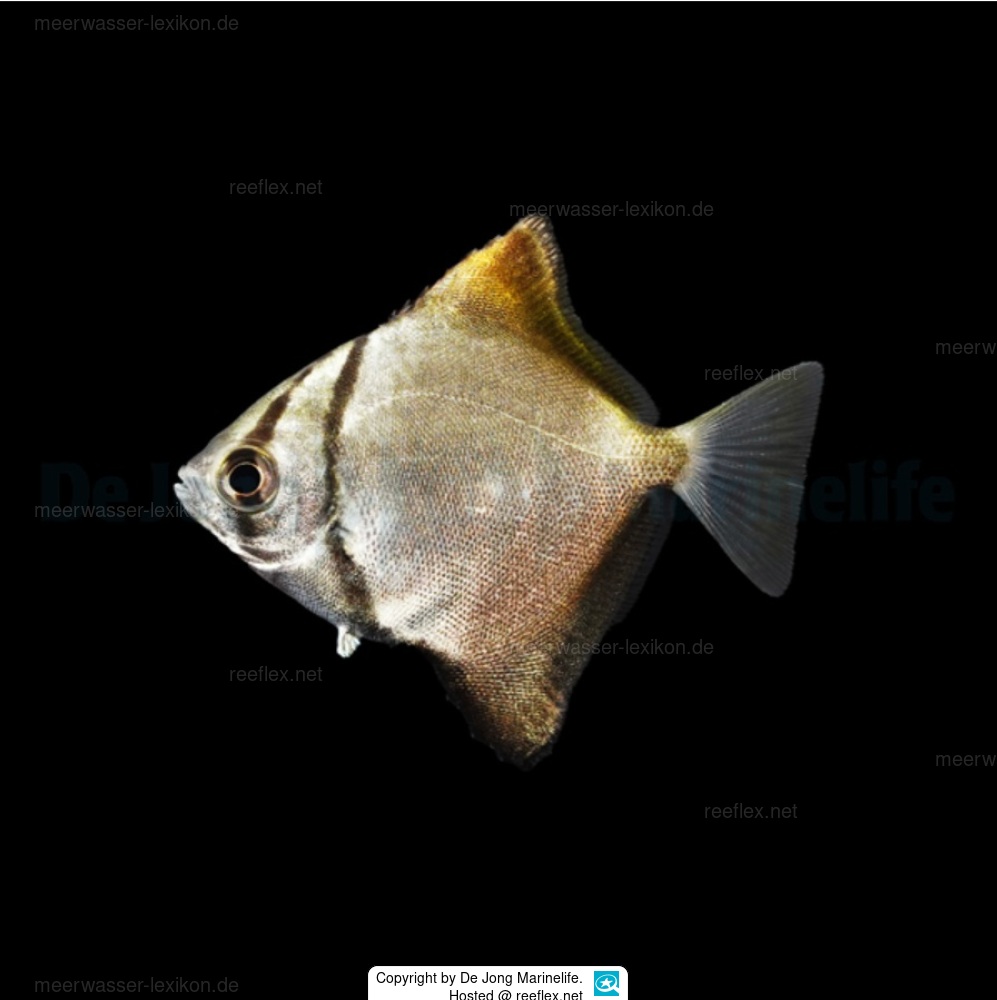
The body of the angel finfish is silvery, disc-shaped, and strongly compressed laterally; it features two vertical, curved black stripes that run through the eye, as well as another that extends from the base of the pectoral fin to the base of the dorsal fin.
The dorsal and anal fins are dark with black tips; the caudal fin is whitish at the base and light yellow toward the tip.
In its natural habitat, Monodactylus kottelati moves back and forth between freshwater, brackish water, and marine environments.
This protandrous hermaphrodite is a reef spawner, but is often confused with Monodactylus argenteus.
Monodactylus kottelati can be kept in larger aquariums with a balanced diet of meat and plant-based foods, in a large school of conspecifics.
But be careful:
Monodactylus kottelati is extremely sensitive to poor water conditions!
Long-term keeping in freshwater leads to fin rot, fungal infections, and faded colors.
Maintain high oxygen levels in your tank and perform regular water changes to prevent stress and disease.
The optimal pH should be between 7.5 and 8.5, and the salinity should be between SG 1.005 and 1.015 using sea salt.
High-flow filtration is recommended; mangrove roots support the well-being of this species. Small fish should not be added, as they may be disturbed by the species’ restless feeding behavior (feeding frenzies of the school).
None of the specialized literature available to us documents exact water depths for this species; one reference comes from the report on “Range extension and first report of Monodactylus kottelati (Perciformes: Monodactylidae) from Chilika Lagoon, east coast of India,” which notes that the lagoon is a maximum of 5 meters deep.
FishBase lists a maximum size of 7.8 cm, the Encyclopaedia Fish Atlas reports a size of 12 cm in aquariums, and Glaser’s Aquarium reports sizes up to 20 cm; in the description mentioned above, a specimen caught in Chilika Lagoon is listed as 12.6 cm SL.
Why are there often significant discrepancies in the size measurements for fish?
In ichthyology, two measurements are used:
SL: Side length = the body length of a fish from the tip of the snout to the end of the spine (the base of the caudal fin), excluding the caudal fin itself.
TL: Total length = the total length of the fish from the tip of the snout to the end of the fully extended caudal fin
Unfortunately, these very abbreviations are often missing in non-scientific sources, and that’s where the problems begin.
Etymology:
The species name “kottelati” honors the Swiss ichthyologist Maurice Kottelat (born 1957) for his interest in and work on the systematics of Sri Lanka’s freshwater fish, where this species occurs in marine, brackish, and freshwater habitats (also known from eastern India).
The dorsal and anal fins are dark with black tips; the caudal fin is whitish at the base and light yellow toward the tip.
In its natural habitat, Monodactylus kottelati moves back and forth between freshwater, brackish water, and marine environments.
This protandrous hermaphrodite is a reef spawner, but is often confused with Monodactylus argenteus.
Monodactylus kottelati can be kept in larger aquariums with a balanced diet of meat and plant-based foods, in a large school of conspecifics.
But be careful:
Monodactylus kottelati is extremely sensitive to poor water conditions!
Long-term keeping in freshwater leads to fin rot, fungal infections, and faded colors.
Maintain high oxygen levels in your tank and perform regular water changes to prevent stress and disease.
The optimal pH should be between 7.5 and 8.5, and the salinity should be between SG 1.005 and 1.015 using sea salt.
High-flow filtration is recommended; mangrove roots support the well-being of this species. Small fish should not be added, as they may be disturbed by the species’ restless feeding behavior (feeding frenzies of the school).
None of the specialized literature available to us documents exact water depths for this species; one reference comes from the report on “Range extension and first report of Monodactylus kottelati (Perciformes: Monodactylidae) from Chilika Lagoon, east coast of India,” which notes that the lagoon is a maximum of 5 meters deep.
FishBase lists a maximum size of 7.8 cm, the Encyclopaedia Fish Atlas reports a size of 12 cm in aquariums, and Glaser’s Aquarium reports sizes up to 20 cm; in the description mentioned above, a specimen caught in Chilika Lagoon is listed as 12.6 cm SL.
Why are there often significant discrepancies in the size measurements for fish?
In ichthyology, two measurements are used:
SL: Side length = the body length of a fish from the tip of the snout to the end of the spine (the base of the caudal fin), excluding the caudal fin itself.
TL: Total length = the total length of the fish from the tip of the snout to the end of the fully extended caudal fin
Unfortunately, these very abbreviations are often missing in non-scientific sources, and that’s where the problems begin.
Etymology:
The species name “kottelati” honors the Swiss ichthyologist Maurice Kottelat (born 1957) for his interest in and work on the systematics of Sri Lanka’s freshwater fish, where this species occurs in marine, brackish, and freshwater habitats (also known from eastern India).

