



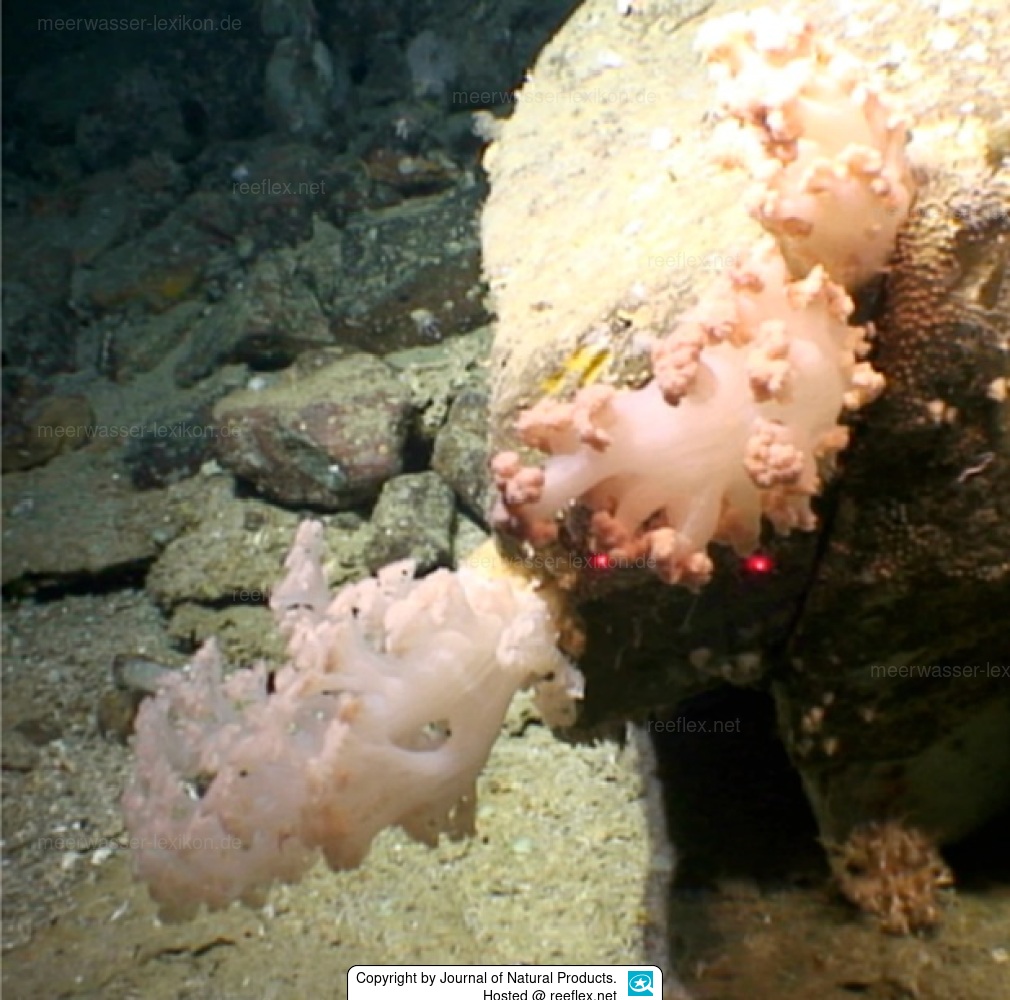
 Journal of Natural Products

Info
Note on the original description by Rathke, 1806:
Interested aquarists often enjoy reading the original description(s) of species to gain a deeper understanding of marine animals.
In doing so, one should always take care to determine whether the material is fresh or preserved; descriptions based on preserved material very often result in significant color discrepancies.
The colony described was referred to as “dark brown,” likely due to the age of the material.
Live material could be pink, ochre, or gray; no confirmation of the color could be found.
We also had to conduct extensive research to find suitable data on the size of living colonies; Rathke had a colony measuring 12 cm in length, of which 3.5 cm was accounted for by the sterile stalk.
It was not until the publication by “Fisheries and Oceans,” *Avoidance and Mitigation of Coral and Sponge Species During Exploratory Drilling Activities Offshore Newfoundland and Labrador*, that we found the following note on page 131: “Height
Interested aquarists often enjoy reading the original description(s) of species to gain a deeper understanding of marine animals.
In doing so, one should always take care to determine whether the material is fresh or preserved; descriptions based on preserved material very often result in significant color discrepancies.
The colony described was referred to as “dark brown,” likely due to the age of the material.
Live material could be pink, ochre, or gray; no confirmation of the color could be found.
We also had to conduct extensive research to find suitable data on the size of living colonies; Rathke had a colony measuring 12 cm in length, of which 3.5 cm was accounted for by the sterile stalk.
It was not until the publication by “Fisheries and Oceans,” *Avoidance and Mitigation of Coral and Sponge Species During Exploratory Drilling Activities Offshore Newfoundland and Labrador*, that we found the following note on page 131: “Height


