Chewbacca


Info
Chelmon rostratus, Linnaeus, 1758
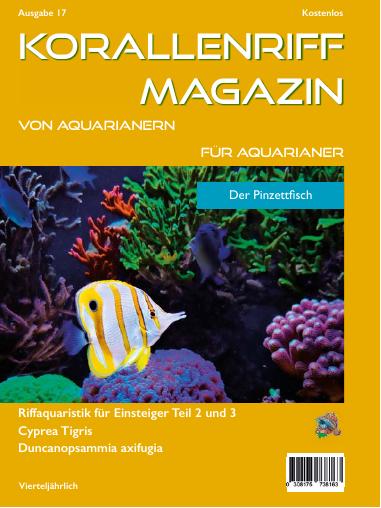
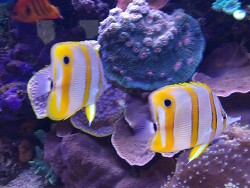
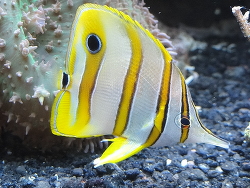
Chelmon rostratus also commonly referred as the Copperband Butterfly or Beaked Coralfish , it occurs in tropical marine waters on coastal reefs and estuaries of the Indo-West Pacific.
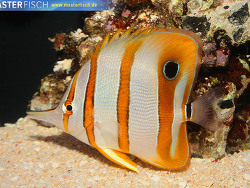
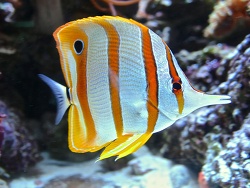
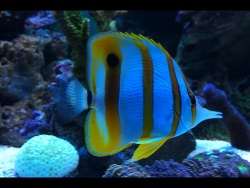
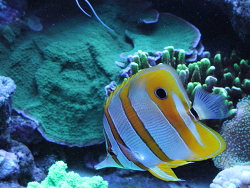
The Beaked Coralfish has a very long snout and tall dorsal and anal fins. It has three orange bars and an ocellus on the dorsal fin rays. There is a dark-margined orange bar through the eye and a blue-edged bar across the caudal peduncle. The long snout of adults is not present in larvae or juveniles. It develops after the larval fish settles on the reef.
Chelmon rostratus is closely related to the Chelmon muelleri which fares notably better in captivity than its shorter-snouted relative. The Copperband Butterfly is also very similar to the Margined Coralfish (Chelmon marginalis). In fact, juveniles of the two species are almost indistinguishable (young Chelmon rostratus have a wider midbody bar). As Chelmon marginalis matures, it loses the black eye-spot at the base of the dorsal fin, which differentiates it from adult Chelmon rostratus.
Most individuals can be kept in a reef tank with most soft corals and small-polyped stony corals - although some individuals may nip at large-polyped stony corals, certain soft corals and zoanthids. One advantage in keeping a Chelmon rostratus in a reef tank is that most will eat Aiptasia; however, some individuals will ignore them. One possible drawback to housing this fish in a reef tank is that it will decimate polychaete worm populations.
Chelmon rostratus reaches a maximum length of about 20 - 21 cm in the wild but It may not get this big in captivity. A Copperband Butterfly will often behave aggressively toward members of its species. When they fight, they ram their heads together and push against each other. It is prudent to keep only one Chelmon rostratus per tank. If one have a very large tank, it is possible to keep a male-female pair - however, the sexes are difficult to distinguish. This fish may exhibit aggression toward other members of the genus Chelmon, but will usually ignore and is typically ignored by other butterflyfishes. As you can see now, the Copperband Butterflyfish is a challenging fish to keep.
Remarks:
Butterflyfish are not recommended for reefs as they will pick at or eat a wide variety of corals, fan worms, and other invertebrates. Most Butterflyfish are known to pick at Aiptaisia, a parasitic anemone.
Synonyms:
Chaelmo rostratus (Linnaeus, 1758)
Chaetodon enceladus Shaw, 1791
Chaetodon rostratus Linnaeus, 1758
Chelmo rostratus (Linnaeus, 1758)
Chelmon lol Montrouzier, 1857
The term "reef safe" is often used in marine aquaristics, especially when buying a new species people often ask if the new animal is "reef safe".
What exactly does reef safe mean?
To answer this question, you can ask target-oriented questions and inquire in forums, clubs, dealers and with aquarist friends:
- Are there already experiences and keeping reports that assure that the new animal can live in other suitably equipped aquariums without ever having caused problems?
- Is there any experience of invertebrates (crustaceans, hermits, mussels, snails) or corals being attacked by other inhabitants such as fish of the same or a different species?
- Is any information known or expected about a possible change in dietary habits, e.g., from a plant-based diet to a meat-based diet?
- Do the desired animals leave the reef structure "alone", do they constantly change it (boring starfish, digger gobies, parrotfish, triggerfish) and thus disturb or displace other co-inhabitants?
- do new animals tend to get diseases repeatedly and very quickly and can they be treated?
- Do known peaceful animals change their character in the course of their life and become aggressive?
- Can the death of a new animal possibly even lead to the death of the rest of the stock through poisoning (possible with some species of sea cucumbers)?
- Last but not least the keeper of the animals has to be included in the "reef safety", there are actively poisonous, passively poisonous animals, animals that have dangerous biting or stinging weapons, animals with extremely strong nettle poisons, these have to be (er)known and a plan of action should have been made in advance in case of an attack on the aquarist (e.g. telephone numbers of the poison control center, the treating doctor, the tropical institute etc.).
If all questions are evaluated positively in the sense of the animal(s) and the keeper, then one can assume a "reef safety".
Chelmon rostratus also commonly referred as the Copperband Butterfly or Beaked Coralfish , it occurs in tropical marine waters on coastal reefs and estuaries of the Indo-West Pacific.
The Beaked Coralfish has a very long snout and tall dorsal and anal fins. It has three orange bars and an ocellus on the dorsal fin rays. There is a dark-margined orange bar through the eye and a blue-edged bar across the caudal peduncle. The long snout of adults is not present in larvae or juveniles. It develops after the larval fish settles on the reef.
Chelmon rostratus is closely related to the Chelmon muelleri which fares notably better in captivity than its shorter-snouted relative. The Copperband Butterfly is also very similar to the Margined Coralfish (Chelmon marginalis). In fact, juveniles of the two species are almost indistinguishable (young Chelmon rostratus have a wider midbody bar). As Chelmon marginalis matures, it loses the black eye-spot at the base of the dorsal fin, which differentiates it from adult Chelmon rostratus.
Most individuals can be kept in a reef tank with most soft corals and small-polyped stony corals - although some individuals may nip at large-polyped stony corals, certain soft corals and zoanthids. One advantage in keeping a Chelmon rostratus in a reef tank is that most will eat Aiptasia; however, some individuals will ignore them. One possible drawback to housing this fish in a reef tank is that it will decimate polychaete worm populations.
Chelmon rostratus reaches a maximum length of about 20 - 21 cm in the wild but It may not get this big in captivity. A Copperband Butterfly will often behave aggressively toward members of its species. When they fight, they ram their heads together and push against each other. It is prudent to keep only one Chelmon rostratus per tank. If one have a very large tank, it is possible to keep a male-female pair - however, the sexes are difficult to distinguish. This fish may exhibit aggression toward other members of the genus Chelmon, but will usually ignore and is typically ignored by other butterflyfishes. As you can see now, the Copperband Butterflyfish is a challenging fish to keep.
Remarks:
Butterflyfish are not recommended for reefs as they will pick at or eat a wide variety of corals, fan worms, and other invertebrates. Most Butterflyfish are known to pick at Aiptaisia, a parasitic anemone.
Synonyms:
Chaelmo rostratus (Linnaeus, 1758)
Chaetodon enceladus Shaw, 1791
Chaetodon rostratus Linnaeus, 1758
Chelmo rostratus (Linnaeus, 1758)
Chelmon lol Montrouzier, 1857
The term "reef safe" is often used in marine aquaristics, especially when buying a new species people often ask if the new animal is "reef safe".
What exactly does reef safe mean?
To answer this question, you can ask target-oriented questions and inquire in forums, clubs, dealers and with aquarist friends:
- Are there already experiences and keeping reports that assure that the new animal can live in other suitably equipped aquariums without ever having caused problems?
- Is there any experience of invertebrates (crustaceans, hermits, mussels, snails) or corals being attacked by other inhabitants such as fish of the same or a different species?
- Is any information known or expected about a possible change in dietary habits, e.g., from a plant-based diet to a meat-based diet?
- Do the desired animals leave the reef structure "alone", do they constantly change it (boring starfish, digger gobies, parrotfish, triggerfish) and thus disturb or displace other co-inhabitants?
- do new animals tend to get diseases repeatedly and very quickly and can they be treated?
- Do known peaceful animals change their character in the course of their life and become aggressive?
- Can the death of a new animal possibly even lead to the death of the rest of the stock through poisoning (possible with some species of sea cucumbers)?
- Last but not least the keeper of the animals has to be included in the "reef safety", there are actively poisonous, passively poisonous animals, animals that have dangerous biting or stinging weapons, animals with extremely strong nettle poisons, these have to be (er)known and a plan of action should have been made in advance in case of an attack on the aquarist (e.g. telephone numbers of the poison control center, the treating doctor, the tropical institute etc.).
If all questions are evaluated positively in the sense of the animal(s) and the keeper, then one can assume a "reef safety".