


 Journal of the Ocean Science Foundation


Info
Enneapterygius viridicauda is only known from the southwest of Flores, Indonesia.
The species has been observed at depths of 1-5 meters in a mixed habitat of coral, sponges and algae that is exposed to waves and surf throughout the year.
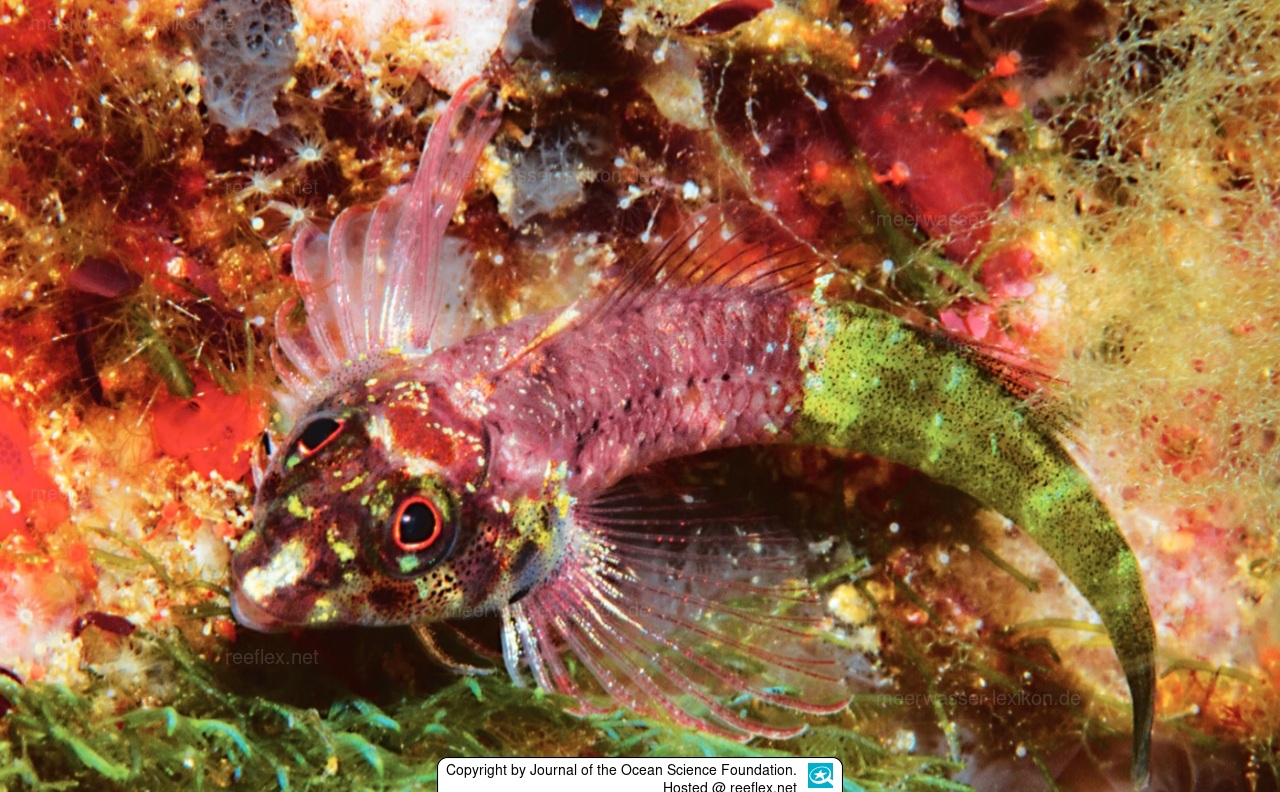
Their unusual pink-green body coloration serves as camouflage in this habitat, with the body colors blending into the background.
Males of Enneapterygius viridicauda are pinkish in the front half of the body, with three irregular lighter bars, the front lateral line has a row of 9 dark brown spots and the back half of the body is olive green.
The head is covered with a dark olive-brown mask in front of the eyes and up to the base of the pectoral fins, the cheeks are densely covered with black melanophores.
A vertical blackish stripe is visible at the base of the pectoral fins, the occiput is greenish yellow.
The snout has a few green spots, the eye is dark olive green and the pupil has an orange border.
The anterior membrane of the first dorsal fin is white, while the other membranes of the dorsal fin are translucent and densely covered with melanophores on the basal side.
The anal fin is black, white in front, the tips of the fin rays are also white, while the caudal fin is dark olive green.
All pectoral fin rays are dark red, basally white, the pelvic fins are white.
Females have a similar coloration to the males, but are lighter overall and without a dark head mask.
The most similar species, Enneapterygius flavoccipitis, is widespread in the eastern Indian Ocean and western Pacific, but is absent from Nusa Tenggara (Indonesia), where it is apparently replaced by Enneapterygius viridicauda.
The first author received photos from divers of further specimens of Enneapterygius viridicauda from the Komodo region and eastern Sumbawa, one of the Lesser Sunda Islands.
Etymology. The epithet "viridicauda" refers to the distinctive green tail: "viridis" (Latin) for "green", and "cauda" (Latin) for "tail".
Citation: Fricke, R., Erdmann, M.V. & Sianipar, A. (2024)
Enneapterygius viridicauda, a new triplefin (Teleostei: Tripterygiidae) from Flores, Indonesia, eastern Indian Ocean.
Journal of the Ocean Science Foundation, 41, 22-29.
The term "reef safe" is often used in marine aquaristics, especially when buying a new species people often ask if the new animal is "reef safe".
What exactly does reef safe mean?
To answer this question, you can ask target-oriented questions and inquire in forums, clubs, dealers and with aquarist friends:
- Are there already experiences and keeping reports that assure that the new animal can live in other suitably equipped aquariums without ever having caused problems?
- Is there any experience of invertebrates (crustaceans, hermits, mussels, snails) or corals being attacked by other inhabitants such as fish of the same or a different species?
- Is any information known or expected about a possible change in dietary habits, e.g., from a plant-based diet to a meat-based diet?
- Do the desired animals leave the reef structure "alone", do they constantly change it (boring starfish, digger gobies, parrotfish, triggerfish) and thus disturb or displace other co-inhabitants?
- do new animals tend to get diseases repeatedly and very quickly and can they be treated?
- Do known peaceful animals change their character in the course of their life and become aggressive?
- Can the death of a new animal possibly even lead to the death of the rest of the stock through poisoning (possible with some species of sea cucumbers)?
- Last but not least the keeper of the animals has to be included in the "reef safety", there are actively poisonous, passively poisonous animals, animals that have dangerous biting or stinging weapons, animals with extremely strong nettle poisons, these have to be (er)known and a plan of action should have been made in advance in case of an attack on the aquarist (e.g. telephone numbers of the poison control center, the treating doctor, the tropical institute etc.).
If all questions are evaluated positively in the sense of the animal(s) and the keeper, then one can assume a "reef safety".
The species has been observed at depths of 1-5 meters in a mixed habitat of coral, sponges and algae that is exposed to waves and surf throughout the year.
Their unusual pink-green body coloration serves as camouflage in this habitat, with the body colors blending into the background.
Males of Enneapterygius viridicauda are pinkish in the front half of the body, with three irregular lighter bars, the front lateral line has a row of 9 dark brown spots and the back half of the body is olive green.
The head is covered with a dark olive-brown mask in front of the eyes and up to the base of the pectoral fins, the cheeks are densely covered with black melanophores.
A vertical blackish stripe is visible at the base of the pectoral fins, the occiput is greenish yellow.
The snout has a few green spots, the eye is dark olive green and the pupil has an orange border.
The anterior membrane of the first dorsal fin is white, while the other membranes of the dorsal fin are translucent and densely covered with melanophores on the basal side.
The anal fin is black, white in front, the tips of the fin rays are also white, while the caudal fin is dark olive green.
All pectoral fin rays are dark red, basally white, the pelvic fins are white.
Females have a similar coloration to the males, but are lighter overall and without a dark head mask.
The most similar species, Enneapterygius flavoccipitis, is widespread in the eastern Indian Ocean and western Pacific, but is absent from Nusa Tenggara (Indonesia), where it is apparently replaced by Enneapterygius viridicauda.
The first author received photos from divers of further specimens of Enneapterygius viridicauda from the Komodo region and eastern Sumbawa, one of the Lesser Sunda Islands.
Etymology. The epithet "viridicauda" refers to the distinctive green tail: "viridis" (Latin) for "green", and "cauda" (Latin) for "tail".
Citation: Fricke, R., Erdmann, M.V. & Sianipar, A. (2024)
Enneapterygius viridicauda, a new triplefin (Teleostei: Tripterygiidae) from Flores, Indonesia, eastern Indian Ocean.
Journal of the Ocean Science Foundation, 41, 22-29.
The term "reef safe" is often used in marine aquaristics, especially when buying a new species people often ask if the new animal is "reef safe".
What exactly does reef safe mean?
To answer this question, you can ask target-oriented questions and inquire in forums, clubs, dealers and with aquarist friends:
- Are there already experiences and keeping reports that assure that the new animal can live in other suitably equipped aquariums without ever having caused problems?
- Is there any experience of invertebrates (crustaceans, hermits, mussels, snails) or corals being attacked by other inhabitants such as fish of the same or a different species?
- Is any information known or expected about a possible change in dietary habits, e.g., from a plant-based diet to a meat-based diet?
- Do the desired animals leave the reef structure "alone", do they constantly change it (boring starfish, digger gobies, parrotfish, triggerfish) and thus disturb or displace other co-inhabitants?
- do new animals tend to get diseases repeatedly and very quickly and can they be treated?
- Do known peaceful animals change their character in the course of their life and become aggressive?
- Can the death of a new animal possibly even lead to the death of the rest of the stock through poisoning (possible with some species of sea cucumbers)?
- Last but not least the keeper of the animals has to be included in the "reef safety", there are actively poisonous, passively poisonous animals, animals that have dangerous biting or stinging weapons, animals with extremely strong nettle poisons, these have to be (er)known and a plan of action should have been made in advance in case of an attack on the aquarist (e.g. telephone numbers of the poison control center, the treating doctor, the tropical institute etc.).
If all questions are evaluated positively in the sense of the animal(s) and the keeper, then one can assume a "reef safety".


