


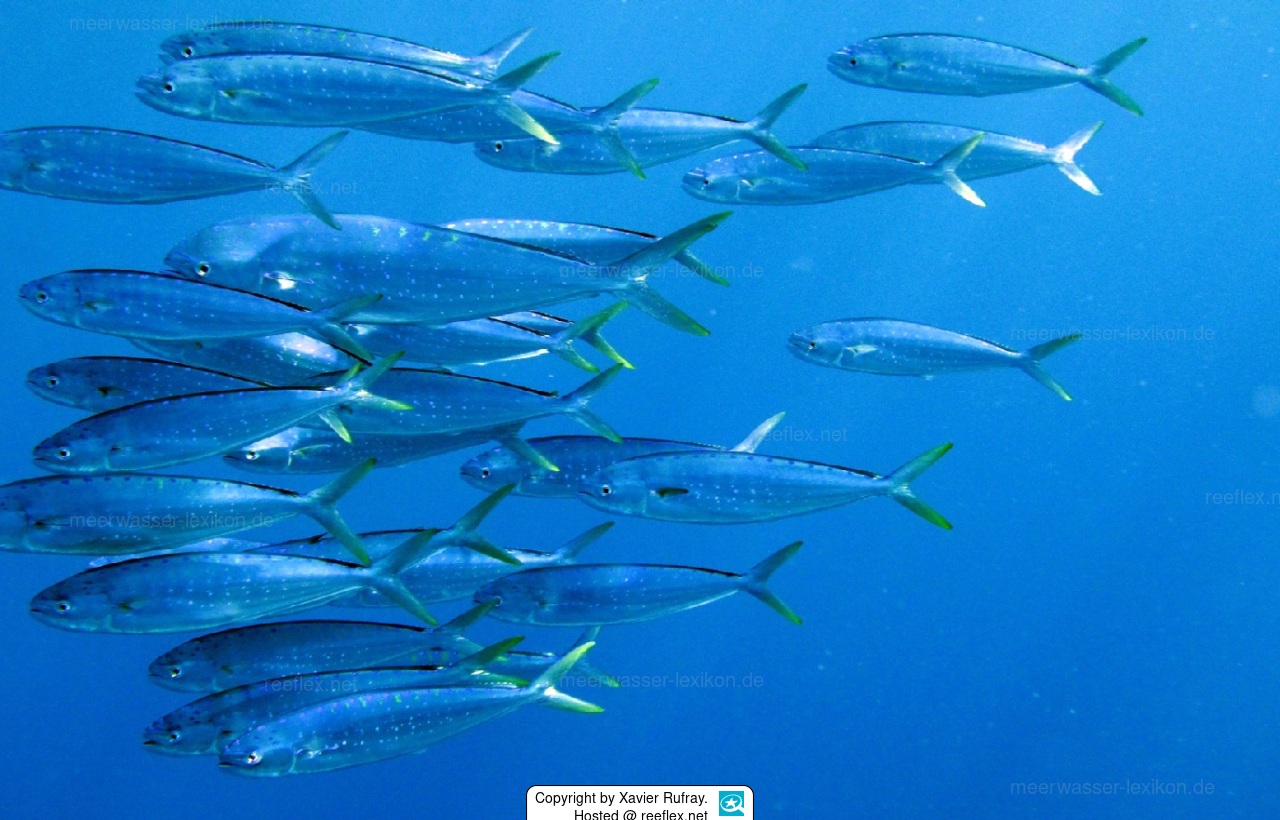
 Xavier Rufray, Frankreich


Info
In parts of its range, Coryphaena equiselis is a highly sought-after sport fish; it is not targeted commercially but is landed as bycatch.
The flesh is sold fresh and tastes excellent.
Coryphaena equiselis is a highly migratory species that lives in nearly all circumpolar and circumsubtropical waters, where it pursues its prey as a swift hunter.
The back of the yellowtail is bright blue and green; the sides are silvery-yellow with golden and metallic hues; and the belly is white or yellow.
Numerous small black spots are scattered across the head and body; juvenile fish have distinct vertical stripes on their sides and a white edge on the caudal fin.
Coryphaena equiselis has an elongated dorsal fin that extends from just behind the eye almost to the caudal fin.
The anal fin is concave; the pectoral fins are about half as long as the head; and the dorsal fin is dark.
This species grows rapidly and has a short lifespan, it reaches sexual maturity at just 3–4 months of age.
Spawning likely occurs year-round at water temperatures above 21 °C (Gibbs and Collette 1959, Ditty 2005, Collette 2010).
It is often mistaken for females or juveniles of the mahi-mahi, Coryphaena hippurus.
The commonly used common name “dolphinfish” has nothing to do with dolphins; Coryphaena equiselis is a fish, whereas a dolphin is a marine mammal.
Etymology:
The species name “equus” means horse; “seta” or “saeta” stands for hair or bristle—a play on the spelling of the plant name “equisaetum” from Pliny the Elder’s *Natural History*, which is usually equated with the vascular plant field horsetail (Equisetum arvense), which Pliny described as “covered with horsehair.”
This allusion is not explained in detail, but likely refers to the fish’s mane-like dorsal fin.
Synonyms:
Coryphaena azorica Valenciennes, 1833 · unaccepted
Coryphaena equisetis Linnaeus, 1758 · unaccepted (misspelling)
Coryphaena equisetis Osbeck, 1765 · unaccepted
Coryphaena lessonii Valenciennes, 1833 · unaccepted
Lampugus neapolitanus Valenciennes, 1833 · unaccepted
Lampugus punctulatus Valenciennes, 1833 · unaccepted
The flesh is sold fresh and tastes excellent.
Coryphaena equiselis is a highly migratory species that lives in nearly all circumpolar and circumsubtropical waters, where it pursues its prey as a swift hunter.
The back of the yellowtail is bright blue and green; the sides are silvery-yellow with golden and metallic hues; and the belly is white or yellow.
Numerous small black spots are scattered across the head and body; juvenile fish have distinct vertical stripes on their sides and a white edge on the caudal fin.
Coryphaena equiselis has an elongated dorsal fin that extends from just behind the eye almost to the caudal fin.
The anal fin is concave; the pectoral fins are about half as long as the head; and the dorsal fin is dark.
This species grows rapidly and has a short lifespan, it reaches sexual maturity at just 3–4 months of age.
Spawning likely occurs year-round at water temperatures above 21 °C (Gibbs and Collette 1959, Ditty 2005, Collette 2010).
It is often mistaken for females or juveniles of the mahi-mahi, Coryphaena hippurus.
The commonly used common name “dolphinfish” has nothing to do with dolphins; Coryphaena equiselis is a fish, whereas a dolphin is a marine mammal.
Etymology:
The species name “equus” means horse; “seta” or “saeta” stands for hair or bristle—a play on the spelling of the plant name “equisaetum” from Pliny the Elder’s *Natural History*, which is usually equated with the vascular plant field horsetail (Equisetum arvense), which Pliny described as “covered with horsehair.”
This allusion is not explained in detail, but likely refers to the fish’s mane-like dorsal fin.
Synonyms:
Coryphaena azorica Valenciennes, 1833 · unaccepted
Coryphaena equisetis Linnaeus, 1758 · unaccepted (misspelling)
Coryphaena equisetis Osbeck, 1765 · unaccepted
Coryphaena lessonii Valenciennes, 1833 · unaccepted
Lampugus neapolitanus Valenciennes, 1833 · unaccepted
Lampugus punctulatus Valenciennes, 1833 · unaccepted


