Anzeige
Fauna Marin GmbH Tunze Osci Motion Aqua Medic Whitecorals.com

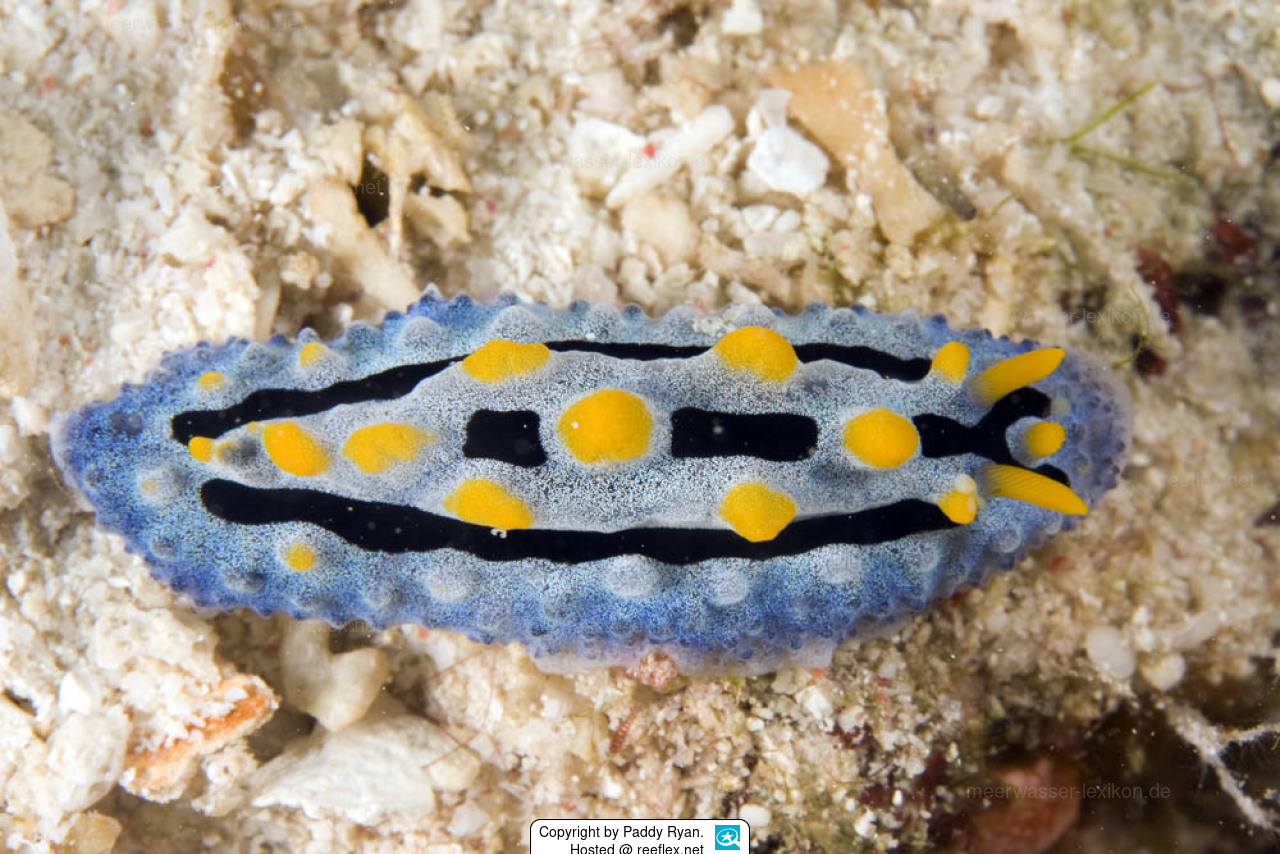
Phyllidia coelestis Sky Blue Phyllidia

Phyllidia coelestis is commonly referred to as Sky Blue Phyllidia. Difficulty in the aquarium: Not suitable for aquarium keeping. Toxicity: Toxic hazard unknown.


Profilbild Urheber Dr. Paddy Ryan, USA

Copyright Dr. Paddy Ryan


Courtesy of the author Dr. Paddy Ryan, USA . Please visit www.ryanphotographic.com for more information.

Uploaded by AndiV.

Image detail


Profile

lexID:
3471 
AphiaID:
212836 
Scientific:
Phyllidia coelestis 
German:
Himmelblaue Warzenschnecke 
English:
Sky Blue Phyllidia 
Category:
Nudibranchs 
Family tree:
Animalia (Kingdom) > Mollusca (Phylum) > Gastropoda (Class) > Nudibranchia (Order) > Phyllidiidae (Family) > Phyllidia (Genus) > coelestis (Species) 
Initial determination:
Bergh, 1905 
Occurrence:
China, Fiji, India, Indian Ocean, Indo Pacific, New Caledonia, Palau, Papua New Guinea, South China Sea, South-Africa, Taiwan, Timor, Vanuatu, Western Pacific Ocean 
Marine Zone:
Subtidal, sublittoral, infralittoral, deep zone of the oceans from the lower limit of the intertidal zone (intertidal) to the shelf edge at about 200 m water depth. neritic. 
Sea depth:
5 - 30 Meter 
Habitats:
Seawater, Sea water 
Size:
up to 2.36" (6 cm) 
Temperature:
24,7 °F - 28,9 °F (24,7°C - 28,9°C) 
Food:
Carnivore, Food specialist, Sponges 
Difficulty:
Not suitable for aquarium keeping 
Offspring:
None 
Toxicity:
Toxic hazard unknown 
CITES:
Not evaluated 
Red List:
Not evaluated (NE) 
Related species at
Catalog of Life:
 
More related species
in this lexicon:
 
Author:
Publisher:
Meerwasser-Lexikon.de
Created:
Last edit:
2024-10-06 10:58:29 

Info

Phyllidia coelestis Bergh, 1905

Phyllidia coelestis occours in the Indo-West Pacific, the South China Sea and the Indian Ocean to South Africa.This species can be found in lagoons and reefs up to 30 m depth.Its diurnal.Celestial Phyllidia feeds on sponges.

Seaslugforum:"Phyllidia coelestis can be distinguished from other similar-looking phyllidiids by colour and pattern: in particular the "Y" shape of the blue-grey dorsal ridges; the yellow-capped mid-dorsal tubercles (which never form a median ridge as in Phyllidia varicosa); the evenly tuberculate, broad, blue-grey mantle margin; and the uniformly grey foot without a dark stripe."

External links

  1. sealifebase (en). Abgerufen am 06.10.2024.
  2. Seaslugforum (en). Abgerufen am 04.09.2021.
  3. Wikipedia (en). Abgerufen am 07.08.2020.

Pictures

Commonly

Copyright Ole Johann Brett, Norwegen
2
Copyright Ole Johann Brett, Norwegen
2
Copyright Dr. Paddy Ryan
1
Copyright Ole Johann Brett, Norwegen
1

Husbandry know-how of owners

0 husbandary tips from our users available
Show all and discuss