


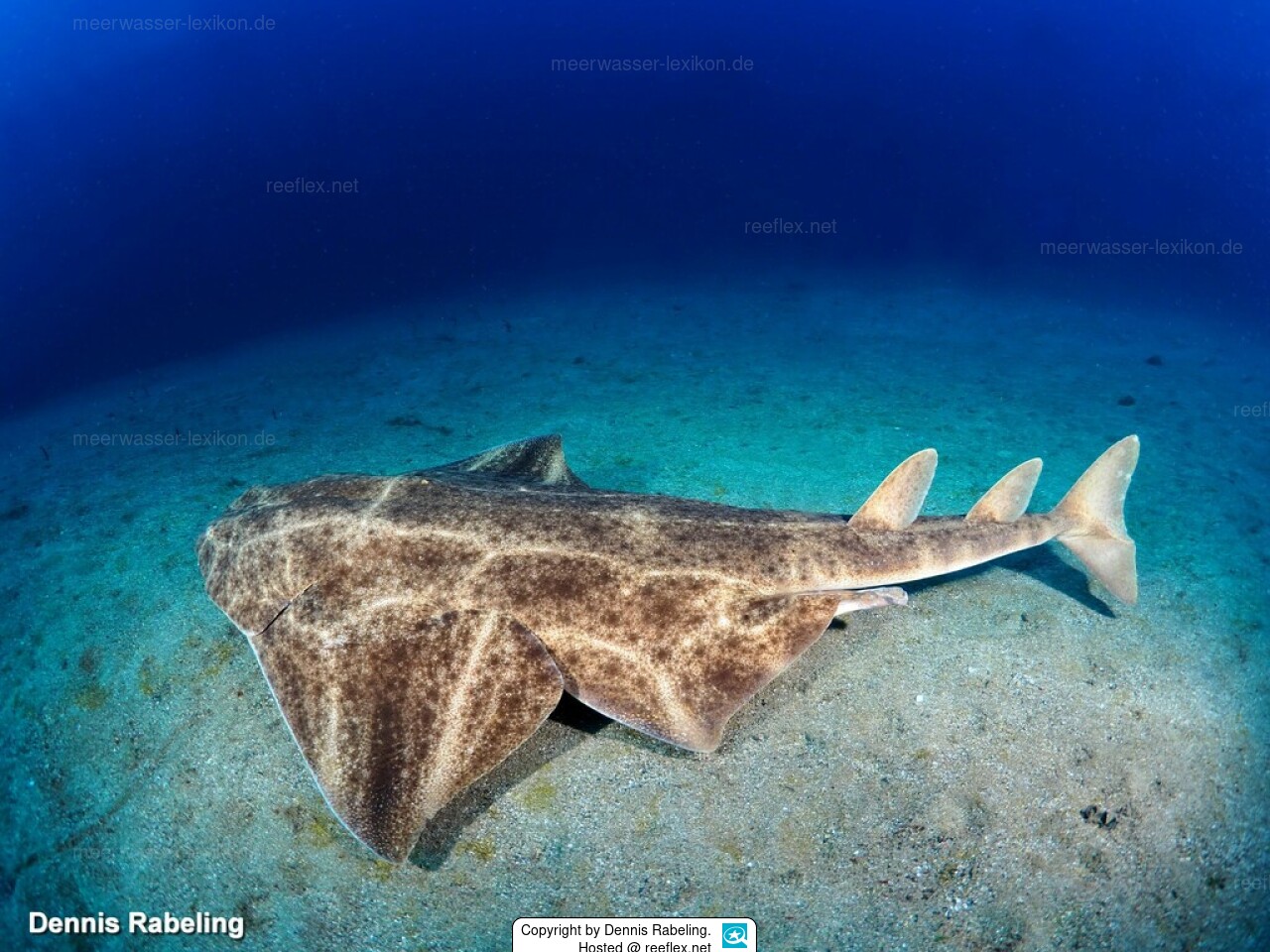
 Dennis Rabeling, Lanzarote, Kanarischen Inseln


Info
Squatina squatina (Linnaeus, 1758)
Distribution:
Northeast Atlantic: southern Norway, Sweden and Shetland Islands to Morocco and West Sahara, including the Canary Islands, the Mediterranean and the Black Sea.
Biology:
benthic species that occurs inshore, on coasts and along the continental shelf;
may enter estuaries.
Found mainly on sand or mud bottoms; sluggish by day, lying buried with eyes protruding.
Shark bites can be quite lethal to humans, especially the 10 most dangerous shark species are considered and can launch unprovoked attacks from humans: - Great white shark - Bull shark - Tiger shark - Sand tiger shark - Blacktip shark - Bronze shark - Spinner shark - Blue shark - Hammerhead shark - Whitetip shark The bite by a shark is one of the most basic fears of humans, but the number of deaths caused by shark attacks is very low: in 2015 there were 98 attacks by sharks and in 6 cases the attack resulted in a fatal end for humans. In 2016 there were 107 attacks by sharks and in 8 cases the attack resulted in a fatal end for humans. Sources: http://hai.ch/Hai-Infos/Unfaelle/index.html http://www.focus.de/reisen/videos/auch-urlaubsorte-betroffen-schrecklicher-rekord-2016-gab-es-mehr-hai-angriffe-als-je-zuvor_id_6519581.html http://www.spiegel.de/wissenschaft/natur/hai-angriffe-erreichen-2015-rekordhoch-weiterer-anstieg-erwartet-a-1076339.html http://www.zeit.de/2016/37/haie-toetung-tierschutz-surfer
In 2022, there were a total of 108 shark attacks in the USA.
Conversely, however, 100 million sharks were killed by humans. http://www.zeit.de/2016/37/haie-toetung-tierschutz-surfer The risk of being bitten by a shark varies greatly from region to region, with most attacks occurring in Florida, Australia and South Africa. Please be careful not to go into the water with bleeding skin wounds, heed bathing warnings from the authorities and be very careful when using surfboards, as sharks can easily confuse the boards with seals and harbour seals. After shark bites, always call a doctor or / and the rescue service as soon as possible, as heavy bleeding can be life-threatening.
https://worldanimalfoundation.org/advocate/shark-attack-statistics/
Synonymised names
Rhina squatina (Linnaeus, 1758) · unaccepted (synonym)
Squalraia acephala de la Pylaie, 1835 · unaccepted (ambiguous synonym)
Squalraia cervicata de la Pylaie, 1835 · unaccepted (ambiguous synonym)
Squalus squatina Linnaeus, 1758 · unaccepted (synonym)
Squatina angelus Blainville, 1825 · unaccepted (synonym)
Squatina angelus Gronow, 1854 · unaccepted (synonym)
Squatina europaea Swainson, 1839 · unaccepted (synonym)
Squatina laevis Cuvier, 1816 · unaccepted (synonym)
Squatina lewis Couch, 1825 · unaccepted (synonym)
Squatina squatini (Linnaeus, 1758) · unaccepted > misspelling - incorrect subsequent spelling
Squatina vulgaris Risso, 1810 · unaccepted (synonym)
Distribution:
Northeast Atlantic: southern Norway, Sweden and Shetland Islands to Morocco and West Sahara, including the Canary Islands, the Mediterranean and the Black Sea.
Biology:
benthic species that occurs inshore, on coasts and along the continental shelf;
may enter estuaries.
Found mainly on sand or mud bottoms; sluggish by day, lying buried with eyes protruding.
Shark bites can be quite lethal to humans, especially the 10 most dangerous shark species are considered and can launch unprovoked attacks from humans: - Great white shark - Bull shark - Tiger shark - Sand tiger shark - Blacktip shark - Bronze shark - Spinner shark - Blue shark - Hammerhead shark - Whitetip shark The bite by a shark is one of the most basic fears of humans, but the number of deaths caused by shark attacks is very low: in 2015 there were 98 attacks by sharks and in 6 cases the attack resulted in a fatal end for humans. In 2016 there were 107 attacks by sharks and in 8 cases the attack resulted in a fatal end for humans. Sources: http://hai.ch/Hai-Infos/Unfaelle/index.html http://www.focus.de/reisen/videos/auch-urlaubsorte-betroffen-schrecklicher-rekord-2016-gab-es-mehr-hai-angriffe-als-je-zuvor_id_6519581.html http://www.spiegel.de/wissenschaft/natur/hai-angriffe-erreichen-2015-rekordhoch-weiterer-anstieg-erwartet-a-1076339.html http://www.zeit.de/2016/37/haie-toetung-tierschutz-surfer
In 2022, there were a total of 108 shark attacks in the USA.
Conversely, however, 100 million sharks were killed by humans. http://www.zeit.de/2016/37/haie-toetung-tierschutz-surfer The risk of being bitten by a shark varies greatly from region to region, with most attacks occurring in Florida, Australia and South Africa. Please be careful not to go into the water with bleeding skin wounds, heed bathing warnings from the authorities and be very careful when using surfboards, as sharks can easily confuse the boards with seals and harbour seals. After shark bites, always call a doctor or / and the rescue service as soon as possible, as heavy bleeding can be life-threatening.
https://worldanimalfoundation.org/advocate/shark-attack-statistics/
Synonymised names
Rhina squatina (Linnaeus, 1758) · unaccepted (synonym)
Squalraia acephala de la Pylaie, 1835 · unaccepted (ambiguous synonym)
Squalraia cervicata de la Pylaie, 1835 · unaccepted (ambiguous synonym)
Squalus squatina Linnaeus, 1758 · unaccepted (synonym)
Squatina angelus Blainville, 1825 · unaccepted (synonym)
Squatina angelus Gronow, 1854 · unaccepted (synonym)
Squatina europaea Swainson, 1839 · unaccepted (synonym)
Squatina laevis Cuvier, 1816 · unaccepted (synonym)
Squatina lewis Couch, 1825 · unaccepted (synonym)
Squatina squatini (Linnaeus, 1758) · unaccepted > misspelling - incorrect subsequent spelling
Squatina vulgaris Risso, 1810 · unaccepted (synonym)


