

 Georgina Jones (CC-BY-SA), Cape Town


Info
Iphimedia gibba (K.H. Barnard, 1955)
Very special thanks for his wonderful photo of Iphimedia gibba to Guido Zsilavecz from Cape Town, South Africa!
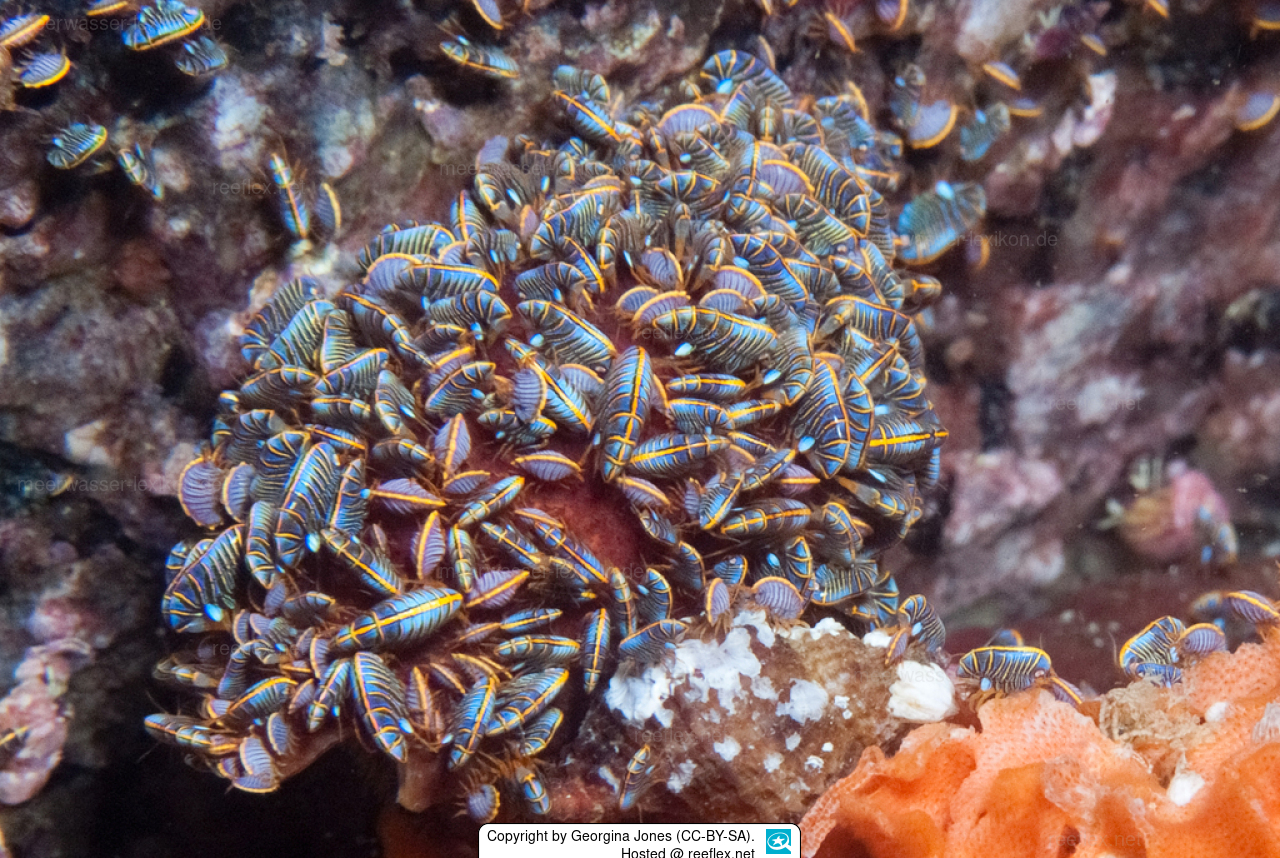
This isopods are commonly known as Hunchback amphipods refered to its hunched body. The head faces is downwards.The background colour is blue with yellow stripes.
The photo was taken off Cape Peninsula (20 m depht) and show the Hunchback amphipods on a red sponge.
Iphimedia gibba O'Donoghue & de Watteville, 1944
Iphimedia gibba is a bryozoan with an unusual range. According to WoRMS, these bryozoans are found in South Africa and Chile. Not only do these bryozoans form unusual colonies, but they also live epizoically on the shells of snails.
The species name “nodosum” is Latin and means “nodular” or “provided with knots,” referring to the characteristic, warty surface of these gelatinous colonies that grow on snail shells.
Iphimedia gibba covers snail shells with a reddish-brown “fur” and is, so to speak, carried around by shelled snails or by hermit crabs that use empty snail shells. In South Africa, it overgrows the paper conch (Burnupena papyracea).
Description of Iphimedia gibba: The dense, crust-forming colony is mamillate, with each mamilla containing a group of large male zooids with tall, funnel-shaped lophophores. Between the mamillae are smaller female zooids with shorter, cup-shaped lophophores. The colony is dark reddish-brown in color.
The mamillary structure of Iphimedia gibba was first described by O’Donoghue and de Watteville (1944). They observed that the mamillae were often arranged “in almost regular rows” (actually spirally parallel to the whorls of the shell), but that this was not due to the shell structure.
According to the book *Two Oceans* by Branch, Griffiths, Branch, and Beckley, Issue 5, 2002, page 74, *Alcyonidium nodosum* is toxic and is eaten by the amphipod *Iphimeda gibba*, which provides the amphipod with protection from predators.
Very special thanks for his wonderful photo of Iphimedia gibba to Guido Zsilavecz from Cape Town, South Africa!
This isopods are commonly known as Hunchback amphipods refered to its hunched body. The head faces is downwards.The background colour is blue with yellow stripes.
The photo was taken off Cape Peninsula (20 m depht) and show the Hunchback amphipods on a red sponge.
Iphimedia gibba O'Donoghue & de Watteville, 1944
Iphimedia gibba is a bryozoan with an unusual range. According to WoRMS, these bryozoans are found in South Africa and Chile. Not only do these bryozoans form unusual colonies, but they also live epizoically on the shells of snails.
The species name “nodosum” is Latin and means “nodular” or “provided with knots,” referring to the characteristic, warty surface of these gelatinous colonies that grow on snail shells.
Iphimedia gibba covers snail shells with a reddish-brown “fur” and is, so to speak, carried around by shelled snails or by hermit crabs that use empty snail shells. In South Africa, it overgrows the paper conch (Burnupena papyracea).
Description of Iphimedia gibba: The dense, crust-forming colony is mamillate, with each mamilla containing a group of large male zooids with tall, funnel-shaped lophophores. Between the mamillae are smaller female zooids with shorter, cup-shaped lophophores. The colony is dark reddish-brown in color.
The mamillary structure of Iphimedia gibba was first described by O’Donoghue and de Watteville (1944). They observed that the mamillae were often arranged “in almost regular rows” (actually spirally parallel to the whorls of the shell), but that this was not due to the shell structure.
According to the book *Two Oceans* by Branch, Griffiths, Branch, and Beckley, Issue 5, 2002, page 74, *Alcyonidium nodosum* is toxic and is eaten by the amphipod *Iphimeda gibba*, which provides the amphipod with protection from predators.


