


 Journal of the Ocean Science Foundation


Info
From the Galapagos Archipelago in Ecuador, South-East Pacific, Dr. Benjamin Victor has described a newly discovered, very colorful and variable flying gurnard, which has been named “Painted Searobin” due to its coloring.
Prionotus pictus is the island sister species of the continental Prionotus albirostris Jordan & Bollman, 1890, with which Prionotus pictus shares the basic morphology and spiny features of the head as well as the jagged spines of the dorsal fin.
The most striking morphological difference is the shape of the snout, which is rounded and smooth in Prionotus pictus when viewed from above, while in Prionotus albirostris it is angular with spiny rostral flanges and a dark midline depression.
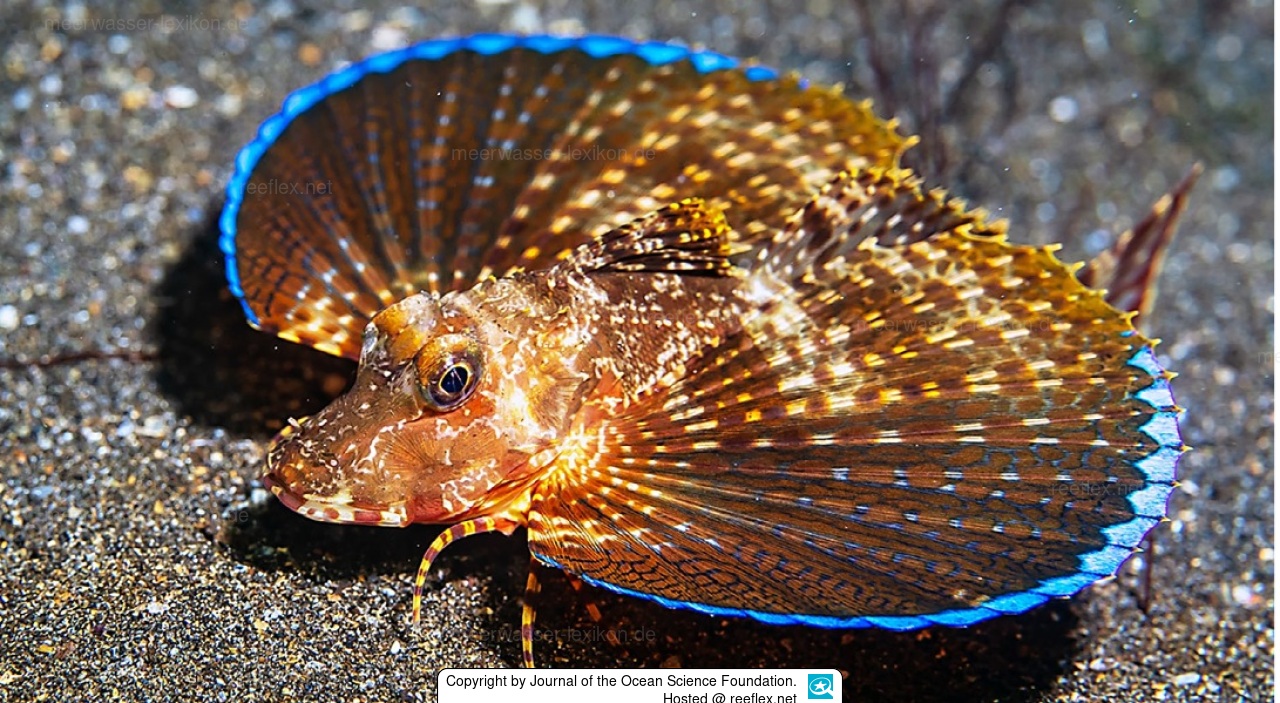
Prionotus pictus exhibits many variable color patterns, each with white net patterns on the head and white speckles on the body in a unique individual pattern (like a fingerprint), with some lateral irregular to rounded large dark spots.
A common color palette is a basic brown with bright orange tones and a distinctive blue border on the pectoral fins; less common patterns include bright red and orange, faded brown, or pale (on white sand) with muted blue, dark brown markings with red ventral coloration, or predominantly black and white.
In all cases, a series of distinctive white spots highlights the porous lateral line scales.
Lip markings are in an individual pattern of irregular red, brown, or purple spots and stripes (not to mention three discrete dark bands on a white background, at the front, center, and corners of the jaw).
The spiny dorsal fin has a white-dark striped front edge of the first spine and irregular brown to black spots on the fin membranes, which become a thick, radial spoke pattern in dark individuals.
The soft dorsal and anal fins have a variable, mostly interrupted stripe along the center of the fin.
The caudal fin of the common form has a dark base followed by a light stripe, usually followed by two alternating dark stripes or a broad stripe with signs of splitting, followed by a thin white posterior margin.
In contrast, dark phases may have conspicuous black radial spokes.
The pectoral fin is spectacular when fanned out, with a thick light blue border on the membranes of the lower 10 rays.
The upper part of the fin is lighter in color and clearly shows three or four indistinct broad dark bands with spots in between (the bands are more clearly visible when the fin is folded).
The lower part of the fin, from the fifth to the tenth membrane, has a large area with distinct orange-brown circles bordered by blue, which become smaller and merge into light distal net structures.
In darker forms, the distal part of the fin turns dark, even black.
The free pectoral fin rays are thick with distinctive, equally wide, broad bands, alternating between dark or orange and white or yellow. Large juveniles appear to show a similar pattern to adults.
Newly settled small juveniles have bright, contrasting markings on an orange background, with two particularly conspicuous black-edged white saddle patches along the midline of the back, located in front of and directly behind the base of the soft dorsal fin, as well as a series of bluish patches along the edges of the pectoral fins, which later develop into bright blue edges on the pectoral fins of adults.
Etymology:
The genus name “Prionotus” comes from the Greek prion, “onos” = saw and “noton” = back.
The species name ‘pictus’ comes from the Latin word for “painted” and refers to the colorful patterns and colors as well as the individual color distribution with white markings that look like splashes of paint.
Prionotus pictus is the island sister species of the continental Prionotus albirostris Jordan & Bollman, 1890, with which Prionotus pictus shares the basic morphology and spiny features of the head as well as the jagged spines of the dorsal fin.
The most striking morphological difference is the shape of the snout, which is rounded and smooth in Prionotus pictus when viewed from above, while in Prionotus albirostris it is angular with spiny rostral flanges and a dark midline depression.
Prionotus pictus exhibits many variable color patterns, each with white net patterns on the head and white speckles on the body in a unique individual pattern (like a fingerprint), with some lateral irregular to rounded large dark spots.
A common color palette is a basic brown with bright orange tones and a distinctive blue border on the pectoral fins; less common patterns include bright red and orange, faded brown, or pale (on white sand) with muted blue, dark brown markings with red ventral coloration, or predominantly black and white.
In all cases, a series of distinctive white spots highlights the porous lateral line scales.
Lip markings are in an individual pattern of irregular red, brown, or purple spots and stripes (not to mention three discrete dark bands on a white background, at the front, center, and corners of the jaw).
The spiny dorsal fin has a white-dark striped front edge of the first spine and irregular brown to black spots on the fin membranes, which become a thick, radial spoke pattern in dark individuals.
The soft dorsal and anal fins have a variable, mostly interrupted stripe along the center of the fin.
The caudal fin of the common form has a dark base followed by a light stripe, usually followed by two alternating dark stripes or a broad stripe with signs of splitting, followed by a thin white posterior margin.
In contrast, dark phases may have conspicuous black radial spokes.
The pectoral fin is spectacular when fanned out, with a thick light blue border on the membranes of the lower 10 rays.
The upper part of the fin is lighter in color and clearly shows three or four indistinct broad dark bands with spots in between (the bands are more clearly visible when the fin is folded).
The lower part of the fin, from the fifth to the tenth membrane, has a large area with distinct orange-brown circles bordered by blue, which become smaller and merge into light distal net structures.
In darker forms, the distal part of the fin turns dark, even black.
The free pectoral fin rays are thick with distinctive, equally wide, broad bands, alternating between dark or orange and white or yellow. Large juveniles appear to show a similar pattern to adults.
Newly settled small juveniles have bright, contrasting markings on an orange background, with two particularly conspicuous black-edged white saddle patches along the midline of the back, located in front of and directly behind the base of the soft dorsal fin, as well as a series of bluish patches along the edges of the pectoral fins, which later develop into bright blue edges on the pectoral fins of adults.
Etymology:
The genus name “Prionotus” comes from the Greek prion, “onos” = saw and “noton” = back.
The species name ‘pictus’ comes from the Latin word for “painted” and refers to the colorful patterns and colors as well as the individual color distribution with white markings that look like splashes of paint.


