Anzeige
Korallenriff Banner

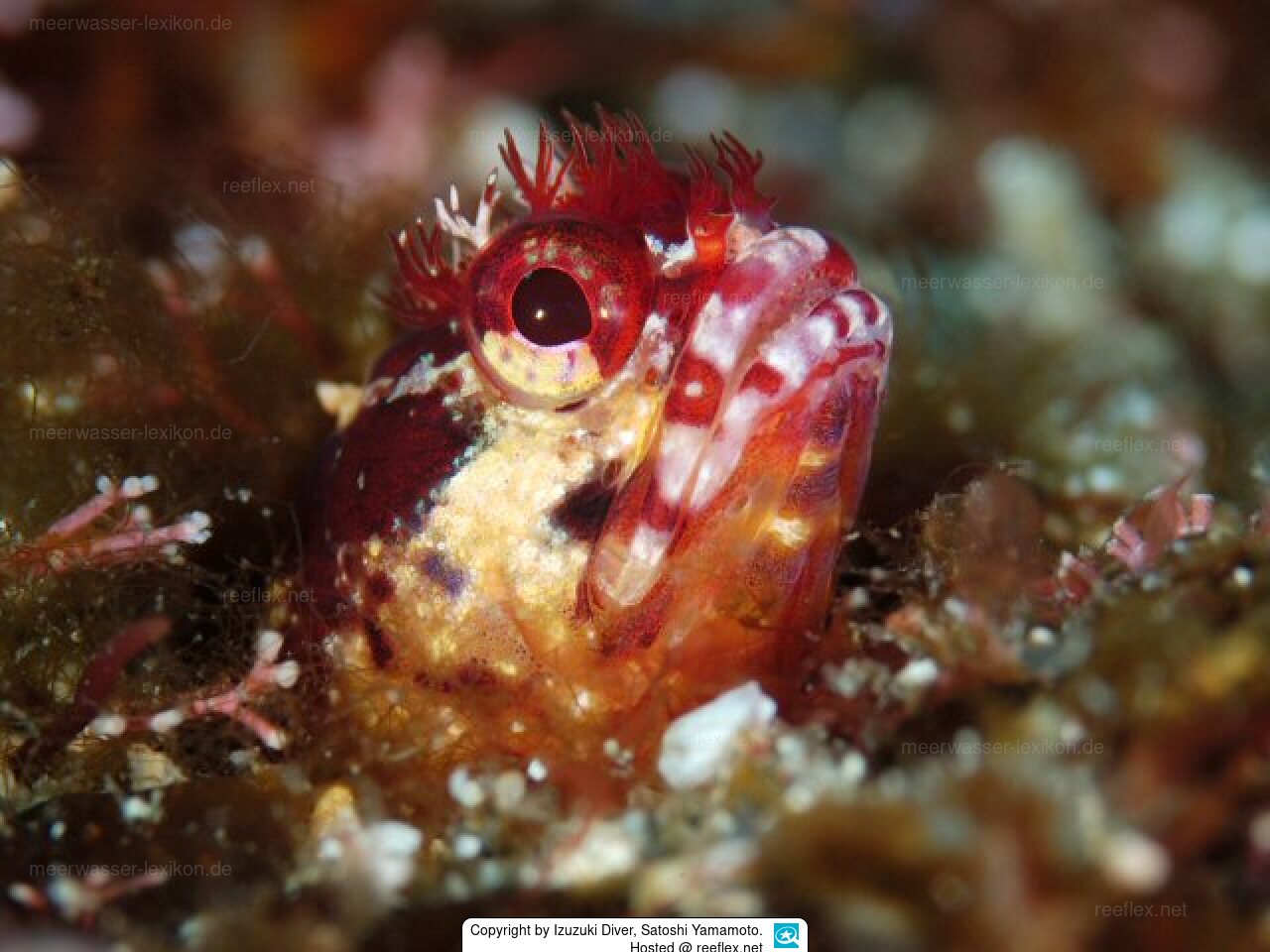
Neoclinus toshimaensis Fringed Head

Neoclinus toshimaensis is commonly referred to as Fringed Head. Difficulty in the aquarium: There are no reports available yet that this animal has already been kept in captivity successfully. Toxicity: Toxic hazard unknown.


Profilbild Urheber Izuzuki Diver, Satoshi Yamamoto, Japan

Foto: Izu Ocean Park, Japan

/ 5 Meter Tiefe
Courtesy of the author Izuzuki Diver, Satoshi Yamamoto, Japan . Please visit www.izuzuki.com for more information.

Uploaded by AndiV.

Image detail


Profile

lexID:
18526 
AphiaID:
Scientific:
Neoclinus toshimaensis 
German:
Fransenkopf 
English:
Fringed Head 
Category:
Pike- Tube- Flagblennies 
Family tree:
Animalia (Kingdom) > Chordata (Phylum) > Teleostei (Class) > Blenniiformes (Order) > Chaenopsidae (Family) > Neoclinus (Genus) > toshimaensis (Species) 
Initial determination:
Fukao, 1980 
Occurrence:
Russland, Corea, Japan, Northwest Pacific, Taiwan 
Marine Zone:
Intertidal (Eulittoral), intertidal zone between the high and low tide lines characterized by the alternation of low and high tide down to 15 meters 
Sea depth:
0 - 9 Meter 
Habitats:
Coastal waters, Coral reefs, Demersal (bottom-dwelling fish), Marine / Salt Water, Protected reefs, Rocky reefs, Tide pools / rock pools 
Size:
up to 2.76" (7 cm) 
Temperature:
53.6 °F - 86 °F (12°C - 30°C) 
Food:
Algae (Algivore), Aquatic plant, Herbivorous 
Difficulty:
There are no reports available yet that this animal has already been kept in captivity successfully 
Offspring:
Not available as offspring 
Toxicity:
Toxic hazard unknown 
CITES:
Not evaluated 
Red List:
Least concern (LC)  
Related species at
Catalog of Life:
 
Author:
Publisher:
Meerwasser-Lexikon.de
Created:
Last edit:
2026-08-09 15:37:52 

Info

This species inhabits exposed rocky reefs just below the low-tide line and feeds on algae (Masuda and Allen 1993).
$alt likes to make its nests in empty shells of Megabalanus volcano (Pilsbry, 1916).

The blenny often pokes its head out of tiny holes, empty mussel shells, or near whip corals and anemones.

Neoclinus toshimaensis comes in a variety of colors, as can be clearly seen in the photos by Satoshi Yamamoto (Izuzuki Diver).

Similar species: Neoclinus toshimaensis Fukao, 1980

Etymology: Toshima is the name of an island where the first specimen of this species was collected.

Pictures

Commonly


Husbandry know-how of owners

0 husbandary tips from our users available
Show all and discuss